Voici la question qui me guide dans mes recherches...

L’appât du gain manifesté par les entreprises supranationales et certains groupes oligarchiques, de même que le contrôle des ressources naturelles par ceux-ci, dirigent l’humanité vers un nouvel ordre mondial de type féodal, voir même sa perte. Confronté à cette situation, l’être humain est invité à refuser d’accepter d’emblée une pseudo-vérité véhiculée par des médias peut-être à la solde de ces entreprises et groupes. Au contraire, il est invité à s’engager dans un processus de discernement et conscientisation afin de créer sa propre vérité par la confrontation de sa réalité nécessairement subjective à des données objectives, telles que révélées par la science, par exemple.

The penalty that good men pay for not being interested in politics is to be governed by men worse than themselves. - Plato
Aucun message portant le libellé technology. Afficher tous les messages

mercredi 28 décembre 2011

L'agriculture verticale et autre technologie au service de l'humanité.

L'agriculture verticale

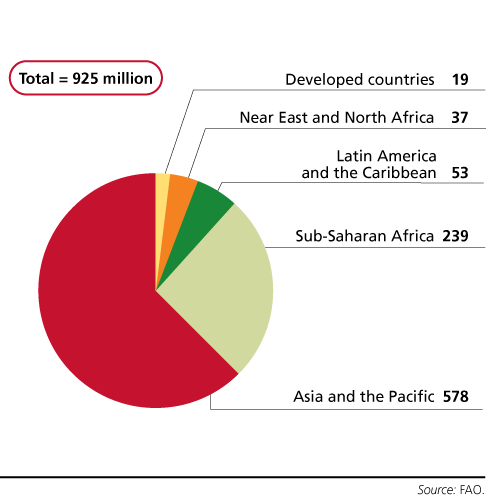
Vous avez sans doute lu les nouvelles récentes : nous avons franchi le cap des 7 milliards d'êtres humains sur la Terre le 31 octobre. Bon, tandis que les petits prophètes de malheur continuent leurs diatribes sur l'impact environnemental de ce qu'ils appellent l'explosion démographique et de l'avènement imminent d'ères de famines, il n'en reste pas moins qu’à l'heure actuelle, 925 millions d’êtres humains manque de nourriture.


Quand l’on regarde les faits, le système économique actuel place plutôt ses priorités dans une consommation éhontée pour un faible pourcentage de la population mondiale et une production de biocarburants utilisant des terres arables pour de l'éthanol. Cela est sans compter le rappel incessant de l'érosion des sols et bientôt le manque de terres arables pour l'agriculture. L'impact de ces pratiques pourrait augmenter alors que la population passera, selon les prédictions de l'O.N.U., à 9 milliards d'habitants en 2050. Une surface équivalente à celle du Brésil serait alors nécessaire pour nourrir tout ce beau monde.

Une économie de 30 à 60 % de nourriture serait possible en améliorant les systèmes de distribution de nourriture et en privilégiant la consommation directe aux humains. C’est le ratio qui se gaspille chaque année, selon l’organisation des Nations Unies pour l’alimentation et l’agriculture – F.A.O..


L'impact néfaste de l'agriculture commerciale actuelle :

L'utilisation massive de pesticides et d'insecticides doit également être abordée, car ils tuent peu à peu les insectes pollinisateurs — voir les débats sur les abeilles des cinq dernières années — et sont potentiellement cancérigènes. L’exploitation massive des terres cause un appauvrissement et une érosion prématurée des sols et un accroissement de la désertification.

Mis à part ces « bonnes » nouvelles, comment peut-on régler d'un seul coup tous ces problèmes tout en embellissant notre environnement? Puisqu'on en parle, aussi bien démontrer que l'innovation humaine ne connaît que les limites imposées par sa propre créativité.

L'idée provient d'un géologue, Gilbert Ellis Bailey, qui a publié en 1915 un livre sur « vertical farming ». Mais c'est Dickson Despommiers, professeur de microbiologie et de sciences environnementales à la New York Colombia University, qui a été incontestablement le fondateur de ce récent mouvement. Parti d'une idée folle, comme il l'a décrit lui-même en 1999. Dans une de ses classes, il parlait de faire de l’agriculture urbaine sur les toits des immeubles.


Le mouvement a pris tel un feu de poudre et s'est répandu très rapidement dans le monde entier en moins d'une décennie. Il lance alors l'idée d'implanter le procédé entièrement à un immeuble de 30 étages. Des architectes se sont alors lancés dans la conception d'éco-environnements, ou un cycle fermé de processus assure une utilisation intelligente des ressources. Dans un tel circuit fermé, rien ne se perd, rien ne se crée. Bien que l'idée ne soit encore qu'au stade expérimental, il existe actuellement six projets du genre :

  1. The Plant à Chicago
  2. Alpha farm à Manchester, qui sera la pièce de résistance pour l'exposition internationale de l'Angleterre en 2013
  3. Un laboratoire de recherche à Suwon, en Corée du Sud, disposé sur trois étages sinon, il reste plusieurs usines à légumes au Japon, ou des compagnies telles que 
  4. Terrasphere
  5. Aerofarms
  6. Valcent Verticrop.
D’une idée toute simple à l'origine a émergé ce que plusieurs appellent la prochaine grande révolution verte.
Ces essais n'en sont qu'à leurs balbutiements. Bien entendu, il demeure quelques obstacles sur la faisabilité d'un tel projet à grande échelle. Comme je le dis toujours, il suffit de combiner les savoirs actuels pour trouver les solutions aux problèmes.

Un des grands défis est l'alimentation électrique de telles structures. Selon certains calculs, cela prendrait huit fois la capacité des centrales électriques actuelles des États-Unis pour fournir la production lumineuse nécessaire à leurs besoins. Cependant, compte tenu des développements récents et progrès en matière de production d'énergie, il serait possible de fournir les besoins énergétiques d'un seul bâtiment grâce à des systèmes de pyrolyse ou gazéification au plasma des déchets, tels ceux fournis par la compagnie Terragon ou Plasco Energy Group. Sinon, à moins qu'il n'y ait une révolution de l'énergie et qu'elle coûte moins chère et soit moins dangereuse à produire (voir centrales nucléaires au thorium ou les réactions nucléaires à basse énergie — LENR), cela risque de poser encore quelques défis.

De nouvelles avancées à l'Université McGill concernant les lumières DEL permettent d'utiliser des spectres de différentes couleurs, pour stimuler la productivité des cultures tout en consommant 10 % de l'énergie des lumières actuelles.

De plus, les immeubles pourraient être construits avec le génie de la nature, tel qu'exposé par Michael Pawlyn. Les fenêtres pourraient être très solides et économiques à construire par un nouveau matériau économique et écologique nommé l’ETFE(2). Il s'agit d'une plaque de polymère pouvant être étiré sur une structure d'acier en trois couches et gonflée à l'air. Son coût est de 24 à 70 % moins à installer comparé au verre, supporte 400 fois son poids, est autonettoyant et recyclable. La lumière naturelle pourrait être ainsi maximisée, et ainsi limiterait l'utilisation de lumière artificielle.

Le volume de fruit et légume produit pourrait également être stimulé par une plus grande concentration de CO2 de l’ordre de 1200 ppm, augmentant potentiellement la croissance de 44 %.


Parlons maintenant des avantages, car ils sont légion :
  • Nous parlons d'une production entièrement biologique et parfaite, 365 jours par année, sans pesticides et insecticides et ceci indépendamment des saisons.
  • Nous parlons d'une commercialisation pouvant donner des milliers d'emplois dans les villes et une distribution locale et rapide de produits frais tout en limitant les dépenses de carburants fossiles.
  • Nous parlons d'un rendement de 5 à 10 fois supérieur à celui de l'agriculture conventionnelle sur 10 fois moins de terrain.
  • Nous parlons d'un procédé pouvant être implanté dans n'importe quel climat, peu importe le pays.
  • Nous parlons d'une économie d'eau de l'ordre de 5 fois comparativement à l'agriculture normale.
  • Bref, nous parlons d'un moyen de nourrir une population croissante, en bonne santé, tout en limitant l'impact environnemental de ce dernier.

Comme mentionné plus haut, tout serait pensé pour fermer le cycle de la consommation : de l'hydroponie combinée à de l'aquaculture, faisant l'élevage de plusieurs espèces de poissons tout en cultivant des laitues. Les déjections des poissons nourrissent les plantes en nutriments, l'eau étant également traitée, filtrée et recyclée. Les poissons seraient nourris grâce aux restes des cultures et des déchets des préparations dans les usines situées en dessous.

Un système de pyrolyse et/ou gazéification utiliserait les déchets non recyclables pour alimenter une partie du bâtiment en électricité, tout en récupérant de l’eau et autre matière. Un biodigesteur de biométhanisation pourrait aussi être utilisé pour prendre le relais avec les restes des usines de transformation des produits.

Des installations aéroponiques pourraient maximiser l'utilisation de l'eau – utilisant seulement 10 % d'eau comparée à l'agriculture intensive — des cultures maraîchères, de tomates, de concombres, de tous les types de salades, d'épinards et de laitues ainsi que des herbes et des épices. Ils peuvent également faire le même traitement grâce à un système de compte-gouttes et de cultures verticales, distribuant l'eau directement aux racines, et s'égouttant à d'autres plateaux superposés.

Une utopie que tout cela? Les projets en vigueur ne sont que les premiers pas vers un avenir meilleur si l'idée continue de faire son chemin tel qu'elle l'a fait déjà. Il est possible de rendre de telles infrastructures viables économiquement tout en augmentant le niveau de la dignité humaine. Le potentiel de ces technologies n'est plus un rêve, mais bien une réalité. Penseurs du monde, vous pouvez encore trouver d'autres manières d'améliorer la vie pour tous, autant pour le genre humain que pour la biodiversité de la planète.

Vidéo résumant bien les possibilités:


Vincent Blanchette

vendredi 14 octobre 2011

De bonne idée pour le transport en commun au Québec.


Le Monorail TrensQuebec comme entreprise nationale de transport.
http://www.trensquebec.qc.ca/

dimanche 2 octobre 2011

Cristina Fernández de Kirchner, opening statment of the Atucha II Nuclear Power Plant.

It's quite rare these days to witness those speeches by a leader.

Listen to Cristina Fernández de Kirchner, president of Argentina, on the opening of a nuclear power station.

Topics in one speech on:

  • Nuclear power
  • Sovereignty rights of a nation
  • Putting an end to debt with the IMF preventing the development of a nation
  • Restructuring the debt of a sovereign nation
  • Workers being the custodians of nation sovereignty
  • Nuclear power being the most important bastions of technological development
  • Foreign interference preventing preventing a nation from having nuclear power
  • A nation govern by itself


More info:

Attucha nuclear power:
http://en.wikipedia.org/wiki/Atucha_II_Nuclear_Power_Plant

Cristina Fernández de Kirchner:
http://en.wikipedia.org/wiki/Cristina_Fern%C3%A1ndez_de_Kirchner

How the IMF Sank Argentina
http://www.commondreams.org/views02/0127-03.htm

samedi 14 mai 2011

Energy from Thorium - Flibe Energy

A new startup company Flibe Energy took the challenge of building a new type of nuclear power station using Thorium which is Safer, Abundant, Cleaner (less waste). What was said on facebook by Kirk Sorenson, the new owner of the company, is that they want to reach criticality around 2015. This means, they will have a testing reactor inside 4 years.


But they are not alone... China, India and other nations are going ahead with their thorium energy plans, I wish them luck.


Here some clip and talks on the subject.... Enjoy

You may need to click for the second clip, problem with the play list.


Some more links to follow:

  • Facebook: https://www.facebook.com/FlibeEnergy
  • Information on Thorium : http://energyfromthorium.com/
  • Flibe Energy: http://www.flibe-energy.com
  • Twitter: http://twitter.com/FlibeEnergy


Reproducing a  post from Energy from Thorium here for reference:


Thorium and the Liquid-Fluoride Reactor: Reduce, Reuse, Recycle


One of the basic principles of the modern environmental movement is the simple mantra to “reduce, reuse, and recycle”. It is my intention to show in this essay that the technology of the liquid-fluoride reactor, coupled with the energy source thorium, make it possible to achieve these goals to a far greater degree than other nuclear energy technologies.

Introduction

Liquid-fluoride reactors are based upon the use of dissolved actinide fluoride salts in a carrier medium of low-absorption fluoride salt solvents. The most common formulations that have been considered and demonstrated for this mission are solvents based around low-melting point mixtures of beryllium fluoride (BeF2) and lithium fluoride (LiF) isotopically enhanced in the more-abundant component lithium-7. The actinide fluorides most commonly employed are thorium tetrafluoride (ThF4) and uranium tetrafluoride (UF4). LiF-BeF2 salt mixtures have very low neutron absorption properties, excellent heat capacity, stability under intense radiation, and the ability to dissolve appreciable amounts of thorium or uranium tetrafluoride.


Liquid and Solid Fluoride Salt Mixtures

Despite providing some degree of neutron moderation, LiF-BeF2 mixtures are not terribly good neutron moderators, thus liquid-fluoride reactors generally employ solid moderating materials in order to moderate neutrons to thermal energies. Graphite is most commonly employed, being abundant, relatively inexpensive, and chemically compatible with the salt. Graphite is not “wetted” by the fluoride salt and can be sealed in ways that limit the intrusion of fission product gases (especially xenon) into the structure of the graphite.
Thorium as a nuclear fuel is not as well-known as uranium, but has properties that have special merit for nuclear use. Thorium also has a number of drawbacks for its use as a common nuclear fuel, but fortunately, by using thorium in fluoride form, nearly all of these drawbacks can be eliminated or strongly mitigated.


Thorium is common in the Earth’s crust, consisting of about 10 parts per million of common continental crust, approximately three to four times more common than uranium. Thorium is not fissile and consists of a single natural isotope (232) but thorium can be converted to a fissile fuel by the absorption of a neutron followed by a short period of beta decay. After absorbing a neutron, thorium-232 is transmuted into thorium-233, which then beta-decays with a half-life of 22 minutes into protactinium-233, which is chemically distinct from the parent thorium. Protactinium-233 has a half-life of about 27 days, after which is beta-decays to uranium-233, which is fissile and has impressive properties. Uranium-233 produces enough neutrons from fission by a thermal neutron to sustain the continued conversion of thorium to energy, even accounting for normal losses, provided that the reactor is neutronically efficient.

Reducing the Production of Transuranic Nuclear Waste

One of the biggest concerns about today’s approach to nuclear power generation concerns our use of low-enrichment uranium (LEU) in solid-uranium-oxide-fueled light-water reactors. In these reactors, LEU fuel is irradiated by thermal neutrons and a significant amount of plutonium is produced from the uranium-238 that makes up 95-97% of the original fuel. Some of this plutonium is consumed as the solid-oxide fuel rod is further irradiated, but from the plutonium other isotopes of plutonium are formed by neutron capture, and then higher actinides like americium and curium are produced. From the small fraction of U-235 present in the fuel even some long-lived neptunium-237 is produced. After an irradiation period of 3-4 years, the fuel rod can no longer sustain addition irradiation and is removed and placed in a spent fuel pool for cooling as high-heating decay products move inevitably towards stability.


In our current approach to civilian nuclear power, these irradiated uranium oxide fuel rods are not reprocessed to separate and partition their different chemical components, but are instead bound for disposal in a deep geological repository in Nevada. There after several hundred years the transuranic actinides still present in the spent nuclear fuel will generate the bulk of the heating that dictates their spacing in the repository and its ultimate capacity. Furthermore, the transuranic actinides carry the vast majority of the radiotoxicity that repository licensers must deal with as they plan for the performance of the repository over the next ten thousand years.
Reducing the amount of transuranic waste that will be sent to any future repository would therefore be an important goal of a future approach to civilian nuclear power generation, and this is eminently doable by using thorium in a liquid-fluoride reactor. Transuranic waste production can be drastically reduced by a clever combination of the inherent properties of the thorium fuel approach and by the flexibility of the liquid-fluoride fuel form.
Thorium, with an atomic mass of 232, begins the nuclear energy generation process at least five neutron absorptions removed from the first transuranic isotope that could be generated. As previously mentioned, thorium-232 absorbs a neutron, transmuting to protactinium-233 and then uranium-233, which is fissile. In a thermal neutron spectrum, uranium-233 tends to fission 90% of the time it absorbs a thermal neutron. The other 10% of the time is converts to uranium-234. Another neutron absorption in uranium-234 leads to conversion to uranium-235, which is also fissile and represents another opportunity for destruction through fission. Uranium-235 fissions in a thermal neutron spectrum approximately 85% of the time, and the other 15% of the time is converted to uranium-236. Uranium-236 has a rather low neutron absorption cross-section, and only after absorbing a neutron is the first transuranic isotope of this approach produced: neptunium-237. Neptunium can be removed from the fluoride salt mixture readily by fluorination from NpF4, which is in solution to NpF6 which is gaseous. Thus, unlike our current approach to nuclear power where the majority of the fuel (97% U-238) is a single neutron absorption away from the production of the first transuranic isotope (Pu-239), in the thorium-based approach, the fuel is five neutron absorptions away from the production of a transuranic isotope, and in the course of those absorptions roughly 98.5% of the original fuel is removed by fission.
Thus, by using thorium in the fluoride reactor rather than uranium in the solid-oxide reactor, it is possible to REDUCE the amount of transuranic material generated by a very large factor.

Reusing Nuclear Fuel

As previously mentioned, today’s approach to nuclear fuel employs low-enrichment uranium is solid-oxide form in zirconium cladding, cooling and moderated by ordinary water. As an oxide, uranium is quite chemically stable and able to achieve high temperatures without melting down. Unfortunately, as an oxide, uranium is also subject to the low thermal conductivities common to most all oxides, and therefore high temperatures at the centerline of the solid fuel element become an inevitable consequence of heat transfer out the surface of the fuel element. In fact, the centerline fuel temperature of a uranium oxide fuel element, relative to the melting temperature of uranium oxide, is one of the key geometrical constraints.


As uranium oxide fuel is irradiated, fission products and transuranics accumulate in the ceramic oxide matrix. Intense radiation from the fission process and the decay of fission products also damages the fuel structure, causing dislocations and swelling in the crystalline matrix. Especially damaging to the fuel element are in the in-growth of gaseous fission products such as xenon and krypton, which further distend and crack the fuel structure. One of the isotopes of xenon (135) has a huge appetite for thermal neutrons and causes control transients during the changing of power settings within the reactor.
After a period of time the uranium oxide fuel element has been depleted of fuel, swollen, cracked, distended, inflated, and compromised by the fission process and must be removed before cladding failure leads to the loss of fission products and other radioactive isotopes to the water loop of the reactor system. Spent solid-oxide fuel rods must be replaced by new fuel rods and are sent to a cooling pond where decay heat can be removed. Although the spent fuel still contains large amounts of unused fuel in the form of both uranium and other actinides, that fuel cannot be accessed until a reprocessing program takes place that involves chemically changing the solid uranium oxide into a liquid uranium nitrate fuel form through the application of strong nitric acid. Then a combination of chemical processes in aqueous and hydrocarbon solvents takes place to separate gaseous fission products, other fission products, transuranics, and uranium from one another. The resulting waste streams from these processes can be utilized productively, but the cost is significant due to the aggressive chemical steps involved and the chemical intensiveness of the new forms.
Many, many recycles of the fuel would be needed to “burn-down” the uranium-238 present in the original spent fuel to energy (through fission) and the costs involved in reprocessing dictate that spent nuclear fuel is rarely subjected to more than one or two recycles before it is disposed.
Thorium and the fluoride reactor present an entirely different approach to fuel management that makes repeated recycling not only easy but economically advantageous. That is because nuclear fuel in the liquid fluoride form rather than in the solid oxide form has distinct advantages. It is already in a chemically stable form as a fluoride. There is no reagent to treat the fuel that will be favored over its current state. Thus it is protected from chemical attack, combustion, burning, or corrosion. But more importantly, as a fluid is it in a form where chemical processes can be employed directly to remove fission products or to add new fuel to compensate for burnup. Additionally, the ionic nature of liquid-fluoride salt renders the fuel essentially impervious to radiation damage. Despite the passage of large amounts of gamma radiation, neutron radiation, alpha radiation, etc. the fuel remains chemically unaltered and with a complete retention of its physical properties.
Gaseous fission products, including the important fission product poison xenon-135, are effortlessly easy to remove from liquid-fluoride salt. They simply come out of solution in the pump bowl during the pumping of the fluid through the loop. This has the additional benefit of keeping pressures low and allowing the reactor to change power states rapidly without concern for the effect of xenon on power changes.


In a modern incarnation of the liquid-fluoride reactor, there are two separate fluoride salts in action in the reactor core: the “fuel salt” and the “blanket salt”. The fuel salt is a mixture of uranium tetrafluoride in the lithium-beryllium fluoride carrier solvent. The uranium consists predominantly of uranium-233 but also contains U-234 and U-236 at equilibrium levels of concentration. Depending on the reprocessing approach it also contains fission products in the form of fluorides. The blanket salt is a mixture of thorium tetrafluoride in the lithium-beryllium fluoride carrier solvent. The blanket salt geometrically surrounds the fuel salt with a graphite barrier between them. Fission in the fuel salt produces neutrons, roughly half of which end up in the blanket salt, transmuting thorium to uranium by neutron absorption followed by beta decay. The uranium formed in the blanket is removed by the simple process of fluorination, whereby uranium as a tetrafluoride in solution is converted to a hexafluoride that is gaseous. Since thorium has no gaseous hexafluoride, it is left behind while uranium is removed in this simple, one-step process. Then the fuel salt is “refueled” by this same stream of fresh uranium hexafluoride by converting it from hexafluoride back into tetrafluoride through contact with hydrogen gas. Thus freshly generated uranium is continuously removed from the blanket salt and added to the core salt, where it subsequently undergoes fission that continues the process all over again.
By keeping fissile materials out of the blanket by continuous reprocessing, the blanket fluid can be kept relatively free of fission products. The fuel salt, on the other hand, will accumulate fission products as uranium fission continues. The most troublesome fission product, xenon, is effortlessly removed by pumping action, but other fission products will become of increasing concern. Samarium, neodymium, and other lanthanides are fission products whose neutron absorption cross-sections are significant enough to merit attention. In order to purify the fuel salt, the first step is to remove the uranium fuel by fluorination. Then the carrier salt (LiF-BeF2) can be distilled from fission product fluorides in a high-temperature still. The remaining fission product fluorides constitute the equivalent of “high-level waste” from fluoride reactor reprocessing. The extracted LiF-BeF2 is recombined with the uranium and reinserted into the reactor core for another cycle of power generation.


The fluid nature of the reactor fluids allow them to be used over and over again, removing only the products that have been generated during operation (uranium in the blanket, fission products in the fuel salt). This ability to continually REUSE the reactor nuclear fuels represents a profound advantage over the solid-fueled uranium approach.

Recycling the “Wastes” of Fission

Fission processes inevitably generate a variety of fission product elements and a large number of isotopes, most of which are neutron-rich and radioactive. The familiar double-humped distribution of fission products reflects the physical reality that each fission event results in two fission products, a “heavy” one and a “light” one. As each of these fission products tends to have many more neutrons than is needed for nuclear stability at its new “station” in life, rapid beta decay generally follows fission and most fission products assume a stable form quite quickly.
When all of the isotopes of an element reach stability it can logically be asked whether or not they are worth chemical extraction and recycling to other, non-nuclear uses.
Consider the case of xenon. Xenon is a noble gas and fission product that accounts for a fair fraction of the mass of fission products from uranium fission. Xenon has a variety of isotopes but the longest lived one (133) has only a half-life of 5.2 days. Therefore, proceeding on the rule-of-thumb that “ten half-lives and you’re gone” after 50 days of storage the xenon remaining from fission would be essentially non-radioactive. In a conventional solid-core reactor the xenon is bound up in the solid-oxide fuel rod and can only be extracted by chopping up and dissolving the fuel element, but in a fluoride reactor it is very easy to extract xenon. In fact, it will come out of solution with essentially no effort at all. Since xenon is a valuable gas, rather than vent the xenon to the atmosphere it can be separated from the krypton by cryogenic distillation and sold. NASA and commercial satellite operators, for instance, use xenon for ion engines for spacecraft. Future NASA missions to Mars that have considered using xenon have had to seriously consider whether the world supply of xenon was sufficient to make such missions possible. Xenon recovered from fission might increase xenon supply.
Another valuable material from fission is neodymium. Within the last 20 years, the discovery of a neodymium-iron-boron alloy that can be used to make super-strong, super-light magnets has caused neodymium demand to increase tremendously. Ironically, one of the markets that is in greatest demand for neodymium is the wind turbine market. They need large electrical generators due to the diffuse nature of the wind energy source, and they need these electrical generators to be as lightweight as possible so that they can be mounted on top of large towers. Neodymium magnets are particularly suited to this demanding application.
Neodymium is the third-most-common element generated from fission (by mass) and also achieves nuclear stability relatively quickly; its longest-lived isotope (147) has a half-life of 10.9 days. By aging the high-level waste from the distillation process in fluoride reactors appropriately, one could extract the neodymium trifluoride from the other fluorides and convert it to a metallic form through electrolysis or metallic reduction. The neodymium would then be available to sell to the burgeoning market.
Xenon and neodymium represent two recycling opportunities where a period of “aging” is needed before the isotopes stabilize and partitioning and marketing is possible. But there are other isotopes in the “waste” stream of a fluoride reactor where the radioactive form of the isotope is the desirable and economic product. An example of this case is the life-saving medical isotope molybdenum-99. Currently, molybdenum-99 is generated in specially-designed medical isotope production reactors in Canada and rushed to medical facilities across North America. Mo-99 decays to technetium-99m, which is then extracted and introduced into human patients in order to facilitate diagnostic procedures. The market for Mo-99 is quite large, but in solid-fueled reactors, the Mo-99 produced by fission is not accessible until the fuel is reprocessed. Since that is an infrequent event in solid-fueled reactors, the overwhelming majority of the Mo-99 produced in such reactors is never productively utilized; rather it simply follows its decay chain to Tc-99. In a fluoride reactor, on the other hand, the fluid nature of the reactor makes it possible to continuously extract Mo-99 along with the other isotopes of molybdenum. Molybdenum forms a volatile hexafluoride much like uranium does, and when the fuel salt is fluorinated, U, Mo, and several other elements come out of solution as gaseous hexafluorides. These can then be separated on from another by distillation at different temperatures, much like crude oil is refined. The molybdenum could then be shipped to medical facilities, where the Mo-99 would decay to Tc-99m that could be chemically extracted and given to patients who need it.
Xenon, molybdenum, and neodymium are three of the most common fission products but many others have value too. The fluid nature of the fluoride reactor makes RECYCLING of the so-called waste quite likely to be economically attractive in many circumstances.

Summary: Reduce, Reuse, Recycle

The environmental dictum of “reduce, reuse, recycle” has been considered in terms of the thorium-fueled, liquid-fluoride reactor and found to be a simple and unifying theme for the options that this technology makes available. Relative to a conventional, solid-fueled uranium reactor, one can drastically REDUCE the generation of transuranic actinides, REUSE the thorium and uranium fuel is a way that allows for complete consumption of the energy resources, and RECYCLE three of the most common fission products into economically useful and even life-saving applications. The thorium-fueled liquid fluoride reactor is worthy of significant further attention, investigation, and funding based on these and many other merits.
samedi 2 avril 2011

Latest news on Japanese nuclear crisis at Fukushima Daiichi


Latest information on the Japanese nuclear crisis at Fukushima Daiichi.

This is the presentation made by Areva on the chronological event leading to the crisis under control today.
fukushima-areva


Other source of information:
Up to date information from GRS (Society for Plant and Reactor Safety) in Germany.

http://jaif.or.jp/english/
Report No. 40: 18:00, April 2

Latest press releases from TepCO, the operator of the nuclear power stations.

samedi 5 mars 2011

IBM Watson against Jeopardy - the future of expert systems

IBM has developed a computer system called Watson to play the game Jeopardy. The real importance of this feat by the IBM researcher is how this technology and knowledge could be applied to other needs of our society.

This could be the turning point for expert system where learning machine and huge databases could help find solutions to any number of problems in a fraction of a second and help human experts make better decisions.

For example, I see such system play a role some day in those area (examples)

  • You are a customer at Bell, you call for a problem with you cell phone.  The system ask you to describe in details to the computer, the nature of your call while you wait for a person.  The system listen all the clues and words of your problem and inside a couple of milliseconds, search through millions of previous documented cases, Q&A and Facts and present the most likely scenario to resolve the issue to the customer representative taking the call.  This could help expedite the time to resolution and the overall satisfaction of both the client and customer representative.
  • You go to the hospital for some symptoms, the nurse ask you for the your basic information and symptoms and take different measurements.  All those informations are "automatically" entered in the expert system and again, searching all medical databases, could come up inside milliseconds with a resolutions, analysis and case urgency that would be added automatically to the patient case file.  The nurse would be then able to better dispatch the patient to a doctor according to those results.  Thus saving life and reducing the wait time by providing better diagnostic.  In this case, the system could be called House, not Watson
  • The are other example of this, Google could have such a system where any questions could be ask online and a complete answer with references and notes would be provided in this format:


View Watson (artificial intelligence software) and over 3,000,000 other topics on Qwiki.

Here's a playlist of the NOVA intro and show, followed by the Jeopardy challenge. 


Want to know more, the New-York times as a good piece on the subject.

samedi 29 janvier 2011

Pourquoi Hydro Québec, payera pratiquement 6x plus pour son électricité?

Selon ce document, Hydro-Québec payera un coût moyen de 13.3 cents/kWh pour l’électricité produite par 12 projets d'éoliennes.

Montréal, le lundi 20 décembre 2010

Appel d’offres visant l’achat de 500 MW d’énergie éolienne : Hydro-Québec Distribution retient 12 soumissions totalisant 291,4 MW


Hydro-Québec Distribution annonce qu'elle retient 12 soumissions pour un total de 291,4 MW dans le cadre de l’appel d’offres lancé le 30 avril 2009 et visant l’achat de deux blocs distincts de 250 MW d’électricité produite au Québec au moyen d’éoliennes, l’un issu de projets autochtones et l’autre, de projets communautaires. Les soumissions retenues sont réparties comme suit pour chacun des blocs : 
  • 1 soumission pour 24,0 MW pour le bloc autochtone ;
  • 11 soumissions pour 267,4 MW pour le bloc communautaire.
Les livraisons d'électricité doivent commencer entre le 1er décembre 2013 et le 1er décembre 2015. Le prix moyen de l'énergie des soumissions retenues est de 13,3 ¢/kWh, ce qui inclut un le coût du transport de 2,0 ¢/kWh pour acheminer l'électricité produite. Ces projets représentent des investissements de l'ordre de 730 millions de dollars pour les parcs éoliens et de 260 millions de dollars pour le transport de l’électricité. Hydro-Québec Distribution complètera les contrats avec les promoteurs au cours des prochains mois. Ces contrats seront par la suite soumis à la Régie de l'énergie pour approbation. Les promoteurs retenus auront la responsabilité d'obtenir toutes les autorisations et tous les permis requis pour la construction des parcs éoliens avant de procéder au début des travaux de construction. Depuis le lancement de l'appel d'offres, Hydro-Québec Distribution a travaillé avec la société Deloitte inc. aux fins de l'application de la procédure d'appel d'offres et d'octroi pour les achats d'électricité et dans le processus d'évaluation des soumissions.
 Liste des soumissions retenues Carte des soumissions retenues Des renseignements additionnels sont accessibles sur le site Web d'Hydro-Québec Distribution, au www.hydroquebec.com/distribution/fr/marchequebecois/index.html.

Et selon ce document, le prix moyen de production d'Hydro-Québec est d'environ 2.3 cents/kWh.

Donc nous allons payer pour l’électricité produite par ces éoliennes, pratiquement plus de 6x le prix du coût moyen de l'électricité produite aujourd'hui par notre société d'État.


Est-ce que ceci prend en compte les variabilités d'un tel réseau d'éoliennes et les infrastructures qui seront nécessaires pour compenser quand le vent ne souffle pas ou trop? Comme nous voyons ici, les variations de l'énergie produite par les parcs éoliens ne sont pas très stables. Comment seront compensées ces variations?


Comment ferons pour être compétitif sur le marché mondial avec une énergie à 13 cents/kWh pensant que la chine produit des réacteurs nucléaire qui produirons à prêt de 100% du temps de l'énergie à 3 cents/kWh?

Les éoliennes appartiennent au passé et non au futur.


Commentaires ?

samedi 25 septembre 2010

Nissan Leaf electric car compared to a Golf TDI clean diesel

I saw an interesting video that is making some wave on the internet and I wondered if I would buy this type of car?  Would it be practical, what would be the pros and cons?

First the video. I hate those kind of video that manipulate your sense of responsibility.


So, does it really help saving the planet to buy those cars?

Let see the numbers side by side between a TDI and LEAF. Disclosure: I own a Jetta TDI and love it.


So in the end, will it save the planet?
You have to consider that the total cost is more for a Leaf for 160,000 km. Since the impact on the environment is proportional to the total cost of a system it make sense to say that the impact of the Leaf will be greater.  You also need to consider the impact of building those batteries and disposing them after at the end of their life.

Personally I would still buy TDI today.  I hope that this will change with the following improvements:

  • Better batteries, based on carbon nano-tubes and ultra-capacitor
  • Faster charging time
  • Longer autonomy on a charge

UPDATES:


  • While commuting the other day with a friend to work, it came to mind that the best way to save gas, money, the environment and many other things is to car pool. In my case, I have cut in half my travel expense by car pooling.  On top of that, I have a friend to talk about the challenges we face as a race.


  • I stumble upon this article that list all the "rare" elements that goes in the construction of a hybrid car.  We love our gadgets, but all those elements need to be mined, extracted, refined, used and after the live of the car, recycled of disposed of.  All this mean cost and an impact on nature if not done properly.  We have to understand that while technologies are good, the more complexity you put in a system, most of the time it means more energy expense attached to it.

lundi 6 septembre 2010

Diesel "greener" than battery cars!

This is not new to me, when I bought my TDI, I calculated the overall cost and came to the conclusion that my TDI would cost less than those hybrid model. This is now confirmed by a study: source

From what I see of the following study, they did not take into account the battery cost, replacement every few years and environmental impact of those complex batteries and technologies. Yet, TDi cost less!

Diesels greener than battery cars, says Swiss gov report
Get a TDi estate not an EV, and save the planet!
By Lewis Page
Swiss boffins have mounted an investigation into the largely unknown environmental burdens of electric cars using lithium-ion batteries, and say that the manufacturing and disposal of batteries presents no insurmountable barriers to electric motoring. However, their analysis reveals that modern diesel cars are actually better for the environment than battery ones.
The revelations come in a new report issued by Swiss government research lab EMPA, titled Contribution of Li-Ion Batteries to the Environmental Impact of Electric Vehicles. The Swiss boffins, having done some major research into the environmental burdens of making and disposing of li-ion batteries - to add to the established bodies of work on existing cars - say that battery manufacture and disposal aren't that big a deal. However, in today's world, with electricity often made by burning coal or gas, a battery car is still a noticeable eco burden:
The main finding of this study is that the impact of a Li-ion battery used in [a battery-powered car] for transport service is relatively small. In contrast, it is the operation phase that remains the dominant contributor to the environmental burden caused by transport service as long as the electricity for the [battery car] is not produced by renewable hydropower ...
A break even analysis shows that an [internal combustion engined vehicle] would need to consume less than 3.9 L/100km to cause lower [environmental impacts] than a [battery car] ... Consumptions in this range are achieved by some small and very efficient diesel [cars], for example, from Ford and Volkswagen.
Actually quite a lot of the new diesels are in the better-than-battery ballpark, according to UK government figures. The notional battery car considered by the EMPA analysts was a Volkswagen Golf with its normal drivetrain replaced by a battery one: but it seems that you would be doing slightly better for the environment to buy an ordinary new Golf with a 1.6 litre "BlueMotion" injected turbodiesel - which would be a lot cheaper. That would consume 3.8 l/100km, not 3.9.
So would a new Mini Cooper D hatchback or a new Ford Focus, actually. And if you could bear to go for something a little smaller - VW Polo rather than Golf - you'd be streets ahead on the environmental front, down as low as 3.4 l/100km with more than 15 per cent of the car's in-service emissions clipped off compared to the 3.9 l/100km battery-car baseline. As the Swiss boffins tell us, it's the in-service energy use and emissions which count most.
You could even treat yourself to a small estate car - the Skoda Fabia - and beat a battery Golf by a large margin in terms of eco-credentials, according to the EMPA analysis.
Of course, battery car lovers will argue that's not the point. Swiss electricity is already largely generated by carbon-free nuclear and hydropower plants (carbon-free provided you don't count all the concrete used to build them, that is). These and other technologies not yet much used (solar, wind, tidal etc) may one day put the battery car far ahead of internal-combustion ones in terms of carbon emissions.
And if nobody buys battery cars now, they'll stay expensive and scarce forever, so it's still possible to view the act of buying one as green even today when they actually do more damage to the environment than the right internal-combustion model.
But if you just want to emit less carbon right away, it seems you should buy a modern eco-diesel rather than an electric vehicle.

mercredi 7 avril 2010

Are gaming points coming out to real world application?

Video Description: Carnegie Mellon University Professor, Jesse Schell, dives into a world of game development which will emerge from the popular "Facebook Games" era.