Voici la question qui me guide dans mes recherches...

L’appât du gain manifesté par les entreprises supranationales et certains groupes oligarchiques, de même que le contrôle des ressources naturelles par ceux-ci, dirigent l’humanité vers un nouvel ordre mondial de type féodal, voir même sa perte. Confronté à cette situation, l’être humain est invité à refuser d’accepter d’emblée une pseudo-vérité véhiculée par des médias peut-être à la solde de ces entreprises et groupes. Au contraire, il est invité à s’engager dans un processus de discernement et conscientisation afin de créer sa propre vérité par la confrontation de sa réalité nécessairement subjective à des données objectives, telles que révélées par la science, par exemple.

The penalty that good men pay for not being interested in politics is to be governed by men worse than themselves. - Plato
Aucun message portant le libellé société. Afficher tous les messages

samedi 21 avril 2012

Kony 2012, our education system and economic system.

You may have heard about the "Kony 2012" campaign?

Kony 2012 is the title of a campaign launched by the organization Invisible Children Inc., focused for now on the half hour video of the same name, which has had a viral diffusion on the internet reaching in a few days almost one hundred million views (it was published only on the 5th March). The campaign aims at supporting the arrest of Joseph Kony, an Ugandan guerrilla leader accused of “crimes against humanity” by the International Criminal Court (ICC) in The Hague.

It is clearly explained in many articles the doubtful aspect of this campaign and the possible connection of this organization to goals not at all related to saving children in Uganda.

We should save ALL the children and stop ALL those abuser of the world, but is this the solution?

Like Jean Ziegler explained in his latest book: Betting on Famine: Why the World Still Goes Hungry
Jean Ziegler, U.N. special rapporteur on the right to food, alerted the more than 500 delegates that while 854 million people went without food in the world last year, enough food was produced to feed 12 billion people. "This is why a child that dies from famine is murder," Ziegler said. The prices of corn, rice and wheat are literally exploding because of market speculation on the basic commodities.
So you see, there a more urgent problems in the world caused by the speculation on many things, the world economies are about to explode because of speculation out of control, why is the world focusing on this "campaign"?


Here's some samples articles from serious and reputable sources:

Beyond “Kony 2012”. What is Happening in Uganda? America's "Invisible" Military Agenda by Daniele Scalea
The United States has intervened in Uganda within the framework of increased militarization in its relationship with the continent, made necessary by the political and trading penetration of China in Africa.

The sending of military advisers to Museveni, possibly a prelude to military escalation (maybe what the Kony 2012 viral campaign wants to achieve?), is to be taken in conjunction with drone bombardments in Somalia, intervention in Libya to overthrow Gaddafi, French intervention in Ivory Coast to depose Gbagbo. Julien Teil’s documentary The Humanitarian War has shown the role, not too clear, of NGOs in preparing the ground for NATO intervention in Libya.

Invisible Children emphasizes the need to send US troops to Uganda at a time when the LRA seems weakened and, according to many people, Kony hasn’t been in the country for years. At this point it does not seem rash to include also Kony 2012 in the arsenal of US soft power that should support the spread – not necessarily in a peaceful way – of Washington’s influence in Africa.

Democracy now: Kony 2012: Ugandans Criticize Popular Video for Backing U.S. Military Intervention in Central Africa

The relationship between Invisible Children and the U.S. government and the Ugandan regime disturbed me a lot. And we started doing more investigation and more research, and that’s how we came out with the revelation that the U.S. ambassador to Uganda in 2009 had actually written a cable, which was revealed through WikiLeaks, in February 2009, indicating that Invisible Children had approached the U.S. embassy and made it known to them that they were going to be conducting campaigns that would advocate and promote the military solution. That was one of the memos.

A second memo, which was actually much more disturbing, said that Invisible Children had provided a tip to Ugandan intelligence services, leading to the arrest of a suspected regime opponent. This suspected regime opponent used to be a child soldier, as well, and had been taken under the care of Invisible Children and was, in fact, staying at one of their facilities in Uganda. He was arrested. And as many people familiar with Uganda know, people that are arrested by intelligence services in Uganda are subjected to torture. Subsequent to his arrest, nine other Ugandans were arrested, and now they face treason charges. And treason in Uganda is punishable by the death penalty.

So the relationship between Invisible Children does not seem to be independent. It seems to be involved in line with the U.S. administration and the Ugandan regime in advocating and pushing the military solution as the only approach, and disregarding the voices of Ugandans such as Bishop Odama, Bishop Ochola, who come from the war-affected region, who have been pushing the resumption of a negotiated solution to this war.
This web site: World Under Control - Helping to expose corruption by the global elite, one truth at a time: have many interesting links and article to debunk this campaign:


All this make me ANGRY and think that there is something wrong with our education system.  I have seen my local school and many kids involved in this campaigns using emotions in the movie to indoctrinate them.

You then wonder why are we here, why are so many of us "buy" this stuff without asking any hard questions, without being critical and skeptics?

Go read this article on education:
The Purpose of Education: Social Uplift or Social Control? - The Path to Deconstructing Democracy
Fichte laid it down that education should aim at destroying free will, so that, after pupils have left school, they shall be incapable, throughout the rest of their lives, of thinking or acting otherwise than as their schoolmasters would have wished.
Wake up people. There are better way of helping Africa.

mercredi 28 décembre 2011

L'agriculture verticale et autre technologie au service de l'humanité.

L'agriculture verticale

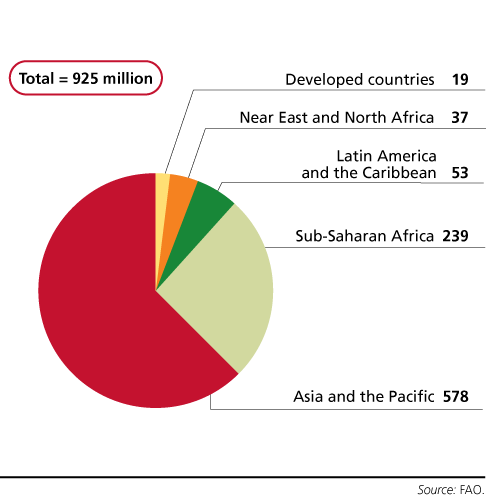
Vous avez sans doute lu les nouvelles récentes : nous avons franchi le cap des 7 milliards d'êtres humains sur la Terre le 31 octobre. Bon, tandis que les petits prophètes de malheur continuent leurs diatribes sur l'impact environnemental de ce qu'ils appellent l'explosion démographique et de l'avènement imminent d'ères de famines, il n'en reste pas moins qu’à l'heure actuelle, 925 millions d’êtres humains manque de nourriture.


Quand l’on regarde les faits, le système économique actuel place plutôt ses priorités dans une consommation éhontée pour un faible pourcentage de la population mondiale et une production de biocarburants utilisant des terres arables pour de l'éthanol. Cela est sans compter le rappel incessant de l'érosion des sols et bientôt le manque de terres arables pour l'agriculture. L'impact de ces pratiques pourrait augmenter alors que la population passera, selon les prédictions de l'O.N.U., à 9 milliards d'habitants en 2050. Une surface équivalente à celle du Brésil serait alors nécessaire pour nourrir tout ce beau monde.

Une économie de 30 à 60 % de nourriture serait possible en améliorant les systèmes de distribution de nourriture et en privilégiant la consommation directe aux humains. C’est le ratio qui se gaspille chaque année, selon l’organisation des Nations Unies pour l’alimentation et l’agriculture – F.A.O..


L'impact néfaste de l'agriculture commerciale actuelle :

L'utilisation massive de pesticides et d'insecticides doit également être abordée, car ils tuent peu à peu les insectes pollinisateurs — voir les débats sur les abeilles des cinq dernières années — et sont potentiellement cancérigènes. L’exploitation massive des terres cause un appauvrissement et une érosion prématurée des sols et un accroissement de la désertification.

Mis à part ces « bonnes » nouvelles, comment peut-on régler d'un seul coup tous ces problèmes tout en embellissant notre environnement? Puisqu'on en parle, aussi bien démontrer que l'innovation humaine ne connaît que les limites imposées par sa propre créativité.

L'idée provient d'un géologue, Gilbert Ellis Bailey, qui a publié en 1915 un livre sur « vertical farming ». Mais c'est Dickson Despommiers, professeur de microbiologie et de sciences environnementales à la New York Colombia University, qui a été incontestablement le fondateur de ce récent mouvement. Parti d'une idée folle, comme il l'a décrit lui-même en 1999. Dans une de ses classes, il parlait de faire de l’agriculture urbaine sur les toits des immeubles.


Le mouvement a pris tel un feu de poudre et s'est répandu très rapidement dans le monde entier en moins d'une décennie. Il lance alors l'idée d'implanter le procédé entièrement à un immeuble de 30 étages. Des architectes se sont alors lancés dans la conception d'éco-environnements, ou un cycle fermé de processus assure une utilisation intelligente des ressources. Dans un tel circuit fermé, rien ne se perd, rien ne se crée. Bien que l'idée ne soit encore qu'au stade expérimental, il existe actuellement six projets du genre :

  1. The Plant à Chicago
  2. Alpha farm à Manchester, qui sera la pièce de résistance pour l'exposition internationale de l'Angleterre en 2013
  3. Un laboratoire de recherche à Suwon, en Corée du Sud, disposé sur trois étages sinon, il reste plusieurs usines à légumes au Japon, ou des compagnies telles que 
  4. Terrasphere
  5. Aerofarms
  6. Valcent Verticrop.
D’une idée toute simple à l'origine a émergé ce que plusieurs appellent la prochaine grande révolution verte.
Ces essais n'en sont qu'à leurs balbutiements. Bien entendu, il demeure quelques obstacles sur la faisabilité d'un tel projet à grande échelle. Comme je le dis toujours, il suffit de combiner les savoirs actuels pour trouver les solutions aux problèmes.

Un des grands défis est l'alimentation électrique de telles structures. Selon certains calculs, cela prendrait huit fois la capacité des centrales électriques actuelles des États-Unis pour fournir la production lumineuse nécessaire à leurs besoins. Cependant, compte tenu des développements récents et progrès en matière de production d'énergie, il serait possible de fournir les besoins énergétiques d'un seul bâtiment grâce à des systèmes de pyrolyse ou gazéification au plasma des déchets, tels ceux fournis par la compagnie Terragon ou Plasco Energy Group. Sinon, à moins qu'il n'y ait une révolution de l'énergie et qu'elle coûte moins chère et soit moins dangereuse à produire (voir centrales nucléaires au thorium ou les réactions nucléaires à basse énergie — LENR), cela risque de poser encore quelques défis.

De nouvelles avancées à l'Université McGill concernant les lumières DEL permettent d'utiliser des spectres de différentes couleurs, pour stimuler la productivité des cultures tout en consommant 10 % de l'énergie des lumières actuelles.

De plus, les immeubles pourraient être construits avec le génie de la nature, tel qu'exposé par Michael Pawlyn. Les fenêtres pourraient être très solides et économiques à construire par un nouveau matériau économique et écologique nommé l’ETFE(2). Il s'agit d'une plaque de polymère pouvant être étiré sur une structure d'acier en trois couches et gonflée à l'air. Son coût est de 24 à 70 % moins à installer comparé au verre, supporte 400 fois son poids, est autonettoyant et recyclable. La lumière naturelle pourrait être ainsi maximisée, et ainsi limiterait l'utilisation de lumière artificielle.

Le volume de fruit et légume produit pourrait également être stimulé par une plus grande concentration de CO2 de l’ordre de 1200 ppm, augmentant potentiellement la croissance de 44 %.


Parlons maintenant des avantages, car ils sont légion :
  • Nous parlons d'une production entièrement biologique et parfaite, 365 jours par année, sans pesticides et insecticides et ceci indépendamment des saisons.
  • Nous parlons d'une commercialisation pouvant donner des milliers d'emplois dans les villes et une distribution locale et rapide de produits frais tout en limitant les dépenses de carburants fossiles.
  • Nous parlons d'un rendement de 5 à 10 fois supérieur à celui de l'agriculture conventionnelle sur 10 fois moins de terrain.
  • Nous parlons d'un procédé pouvant être implanté dans n'importe quel climat, peu importe le pays.
  • Nous parlons d'une économie d'eau de l'ordre de 5 fois comparativement à l'agriculture normale.
  • Bref, nous parlons d'un moyen de nourrir une population croissante, en bonne santé, tout en limitant l'impact environnemental de ce dernier.

Comme mentionné plus haut, tout serait pensé pour fermer le cycle de la consommation : de l'hydroponie combinée à de l'aquaculture, faisant l'élevage de plusieurs espèces de poissons tout en cultivant des laitues. Les déjections des poissons nourrissent les plantes en nutriments, l'eau étant également traitée, filtrée et recyclée. Les poissons seraient nourris grâce aux restes des cultures et des déchets des préparations dans les usines situées en dessous.

Un système de pyrolyse et/ou gazéification utiliserait les déchets non recyclables pour alimenter une partie du bâtiment en électricité, tout en récupérant de l’eau et autre matière. Un biodigesteur de biométhanisation pourrait aussi être utilisé pour prendre le relais avec les restes des usines de transformation des produits.

Des installations aéroponiques pourraient maximiser l'utilisation de l'eau – utilisant seulement 10 % d'eau comparée à l'agriculture intensive — des cultures maraîchères, de tomates, de concombres, de tous les types de salades, d'épinards et de laitues ainsi que des herbes et des épices. Ils peuvent également faire le même traitement grâce à un système de compte-gouttes et de cultures verticales, distribuant l'eau directement aux racines, et s'égouttant à d'autres plateaux superposés.

Une utopie que tout cela? Les projets en vigueur ne sont que les premiers pas vers un avenir meilleur si l'idée continue de faire son chemin tel qu'elle l'a fait déjà. Il est possible de rendre de telles infrastructures viables économiquement tout en augmentant le niveau de la dignité humaine. Le potentiel de ces technologies n'est plus un rêve, mais bien une réalité. Penseurs du monde, vous pouvez encore trouver d'autres manières d'améliorer la vie pour tous, autant pour le genre humain que pour la biodiversité de la planète.

Vidéo résumant bien les possibilités:


Vincent Blanchette

vendredi 14 octobre 2011

De bonne idée pour le transport en commun au Québec.


Le Monorail TrensQuebec comme entreprise nationale de transport.
http://www.trensquebec.qc.ca/

dimanche 2 octobre 2011

Terranova, can we do better?

There's a new show on TV.  


Terranova: another doom and gloom, end of the world scenario where the show start with a view on a polluted city, people with mask to breathe and a population control coops kidnapping the third kid of a family, because it's outlawed to have more than 2. The kids never saw an orange or clouds.. give me a break!

In the year 2149, the planet Earth is a disaster, and most of the plant and animal life has become extinct. Scientists can't reverse the
 damage, but have found a way to travel back to prehistoric times to save the human race.

I am so tired of those shows where humans can only do bad things and the only solution is to go back and live like crazy, unlawful armed farmers.

For starter overpopulation is a myth.. see:

Secondly, we know that by bringing wealth and education to population, their growth rate stabilize.

Third, we know that better technology, cleaner power sources, gives us a cleaner air.  The only task left for humanity is to move from coal power to nuclear power. From what I know, people downtown England breath better today then when they where burning coal in houses.

So I don't believe in those dooms day scenarios, humans are better than that, period.


mardi 28 décembre 2010

Ahhhh... those fun predictions and why we want to believe in them

How do we like to be comforted and feel secure about the future, or how fear and predictions are used to control us.

Take for example this prediction in 2000 that snowfalls in Britain would be a thing of the past. Click images for full resolution.

The column quotes Dr. David Viner of the Climatic Research Unit (CRU) of the University of East Anglia — yes, the epicenter of what would become the Climategate scandal


And now 10 years later...

In this case, it seems that the "models" predicting a warm future free of snow, where not that precise.

There is two lesson to be learn from this.

1. Our pre disposition to want to believe the "experts"
2. The use of "fear" to manipulate you into adopting some kind of doctrine.

Point1:
A good book as been written on this subject:
Future Babble: Why Expert Predictions Fail - and Why We Believe Them Anyway
I think that we are prone to believe anything to comfort our fear of the future and the unknown.  We lack the basic sceptical view of the world, that protect us from those prophets.

Point 2:
Fear has been used throughout the ages to control the population. Politician do it,  Corporations do it, Oligarchs group do it.

Another good book on the subject:
The Science of Fear: How the Culture of Fear Manipulates Your Brain

So next time who hear someone babble about the future, ask yourself what is the intention, the goal of the person or group?  What is their agenda?

Be sceptical about everything you read, always seek the opinions of others, learn the basic facts and science.

As for the explanation of why we believe in all those things... Here's another good book:


Why Do We Believe Impossible Things?


Here's a copy of an article about the book and the author:

Our Belief System Is Powered by Our Tool-Making History, Scientist Says

OPINION By LEE DYE
Sept. 17, 2008—

Why do so many people hold beliefs that are clearly false? A recent story on ABCNews.com said 80 million Americans believe we have been visited by aliens from another planet, and numerous studies show that millions of people believe in ghosts, extrasensory perception and, of course, alien abductions.

According to biologist Lewis Wolpert of University College, London, all those beliefs are clearly false, and they all share a common beginning. It may well have started when the first human realized he, or she, could make a fire by rubbing two sticks together.

Wolpert is the author of a new provocative book exploring the evolutionary origins of belief, called "Six Impossible Things Before Breakfast." The title comes from Lewis Carroll's classic "Through the Looking Glass," when Alice tells the White Queen that she cannot believe in impossible things.

"I dare say you haven't had much practice," the Queen replied. "When I was your age, I always did it for half-an-hour a day. Why, sometimes I've believed as many as six impossible things before breakfast."

Wolpert argues that our wide range of beliefs, some of which are clearly false, grew out of a uniquely human trait. Alone in the animal world, humans understand cause and effect, and that, he says, led ultimately to the invention of tools, the rapid rise of sophisticated technology, and of course, beliefs. Even the earliest humans understood that many events that shaped their lives resulted from specific causes. Therefore, there must be a cause behind every event.

Searching for that cause, Wolpert says, led to the rise of religion because surely there must be some purpose behind all this, some ultimate cause at work in the universe.

Wolpert is an atheist, but he says he isn't trying to convert anyone to atheism. If so, he may be the only person on the planet who is willing to share his deeply held beliefs without caring whether he can convince anyone to believe the same way. But his basic premise is sound. We all know other people, not ourselves of course, who hold some beliefs that are absurd, or at least grossly lacking in evidence. Why?

It all goes back to that first character who rubbed two sticks together.

No other animal has the mental framework for understanding cause and effect, Wolpert says. Chimps, apes and those famously clever New Caledonia crows come close, but they aren't there yet. Once humans reached that point, they turned a corner that ultimately shaped what we are today.

Some animals have used various things as tools, but only humans have put at least two different materials together to fabricate a tool for a specific purpose, and then go on to discover other uses for that same tool. Those first discoveries gave humans an edge on the competition, allowing the species to thrive.

But along the way things happened, some good and some bad. The effort to understand why bad things happen to good people, and so on, gave rise to what Wolpert and others call the "belief engine" in the brain. We want to believe there is a reason for it all, and that leaves us predisposed to believe in some things for which there is little or no evidence. If a certain belief makes sense out of an otherwise senseless event, then it must be true, right?

Wolpert argues that even false beliefs can serve a useful purpose. He concedes that religion, which he regards as false, has a purpose and has played a role in the evolutionary processes. People tend to look out for people of like faith, as in churches, and that support can make them stronger, thus improving the chances that they will live long enough to see their genes passed along.

If Wolpert's compelling argument is right, does that mean we have no control over what we believe? He says he was a very religious child, but became an atheist at the age of 16 because he no longer believed in religion. But could it be that his own "belief engine" made the decision for him?

Ever since Sigmund Freud dug into the secrets of the subconscious, many psychologists have argued that many of our beliefs are beyond our control because they are shaped by unknown secrets buried inside the brain. But if that's true, how do psychologists escape their own scenario? Wouldn't they be just as likely to be deluded as the rest of us?

Similarly, many biologists think the complex organism between our ears is driven entirely by biology. But if we all have a biologically based "belief system," aren't we all -- even biologists -- victims of false beliefs? As Wolpert concedes, maybe people just believe what they want to believe.

None of us approach complex issues, like whether or not to believe in a specific religion, or even a political candidate, with a clean slate.

How else can you explain 80 million Americans who believe we've been visited by aliens? Surely, if aliens invested the enormous costs of interstellar travel and came our way, they must have had a reason. Wouldn't they drop by the White House instead of a desert in New Mexico or Texas? Would there really be any confusion if they had, indeed, visited Earth?

The late astronomer Carl Sagan had a wonderful formula for measuring the truthfulness of any belief. Extraordinary claims, he said, demand extraordinary evidence.

The fact that so many are willing to believe so many impossible things with so little evidence is not comforting.

samedi 9 octobre 2010

Species Extinction - A Real Problem?

When searching on the internet for species extinction, you find a lot of articles linking climate change, global warming and human activities to this issue. I will not go into the "Extinction events" that happens regularly over the ages, this is another subject altogether.


Like anything, opinions diverge a lot of the subject.  One thing I urge people to do before jumping to conclusion if to read on the other side of what the "mass media" is pushing down our easily influenced minds.


So here's a couple of nice articles and documents that give a refreshing look into this species extinction debate.

First let look at a PDF from Dona Laframboise. Here's an excerpt:

Extinction Fiction
The claim by the Intergovernmental Panel on Climate Change that 20-30% of all Earth's species are at risk of extinction relies on a research paper that has been demolished by experts in the field. It is highly debatable whether the authors of this chapter of the 2007 IPCC report comprise the 'worlds top experts'. What is not in dispute is that five out of 10 of the lead authors have documented links to the activist World Wildlife Fund. So do three of the chapter's contributing authors.
Then there is this excellent essay by Stephen Budiansky. Here's an excerpt:
The teflon doomsayers

The astonishingly wrong and repercussion-free prediction of imminent doom that first riveted my attention was the claim of the impending mass extinction of the Earth's species. In 1979, the biologist Norman Myers declared that a fifth of all species on the planet would be gone within two decades. This prediction was based upon . . . absolutely no evidence whatsoever. Myers acknowledged that the documented species extinction rate of animals was 1 per year; he then asserted that scientists had "hazarded a guess" that the actual rate was 100 per year; he then speculated that government inaction was "likely to lead" to several thousand or even tens of thousands a year, which would add up to as much as a million species over two decades. (This was when people thought there were 5 million species; the best guess now is at least 10 million.) It swiftly became conventional wisdom.

Then there is the Where Are The Corpses? essay by Willis Eschenbach
Abstract
The record of continental (as opposed to island) bird and mammal extinctions in the last five centuries was analyzed to determine if the “species-area” relationship actually works to predict extinctions. Very few continental birds or mammals are recorded as having gone extinct, and none have gone extinct from habitat reduction alone. No continental forest bird or mammal is recorded as having gone extinct from any cause. Since the species-area relationship predicts that there should have been a very large number of recorded bird and mammal extinctions from habitat reduction over the last half millennium, I show that the species-area relationship gives erroneous answers to the question of extinction rates.

A must read is the "From Genocide to Ecocide: The Rape of Rapa Nui by Benny Peiser".
ABSTRACT
The ‘decline and fall’ of Easter Island and its alleged self-destruction has become the poster child of a new environmentalist historiography, a school of thought that goes hand-in-hand with predictions of environmental disaster. Why did this exceptional civilisation crumble? What drove its population to extinction? These are some of the key questions Jared Diamond endeavours to answer in his new book Collapse: How Societies Choose to Fail or Survive. According to Diamond, the people of Easter Island destroyed their forest, degraded the island’s topsoil, wiped out their plants and drove their animals to extinction. As a result of this selfinflicted environmental devastation, its complex society collapsed, descending into civil war, cannibalism and self-destruction. While his theory of ecocide has become almost paradigmatic in environmental circles, a dark and gory secret hangs over the premise of Easter Island’s self-destruction: an actual genocide terminated Rapa Nui’s indigenous populace and its culture. Diamond, however, ignores and fails to address the true reasons behind Rapa Nui’s collapse. Why has he turned the victims of cultural and physical extermination into the perpetrators of their own demise? This paper is a first attempt to address this disquieting quandary. It describes the foundation of Diamond’s environmental revisionism and explains why it does not hold up to scientific scrutiny.

And to finish off... You have all those new discoveries


So as you can see, when you dig a little bit, a headline news like this:
Scientists agree world faces mass extinction
Becomes not so clear cut. Always good to be a little skeptical about what we hear and read.

samedi 3 juillet 2010

Which version of democracy you like more?

Version 1


Version 2
demo1.jpg

Or do you have your own ideas about what should democracy be?

jeudi 24 juin 2010

Climate Change Endoheretics Scientists

  • Heresy comes from the Greek hairetikos "able to choose".
  • Heresy is a controversial or novel change to a system of beliefs.
  • Isaac Asimov called Endoheretics appropriately credentialed scientists.
  • The leader of a heretical movement is called a Heresiarch, thus the heresiarch title goes to Al Gore.
  • The Heretics are the followers of the belief system surrounding climate change, thus the IPCC falls in this category
A new “study” has been published in the Proceedings of the National Academy of Sciences (PNAS) which has examined the credentials and publication records of climate scientists who are global warming skeptics versus those who accept the “tenets of anthropogenic climate change”.

For decades governments have thrown hundreds of millions of dollars at Endoheretics climate scientists who sought to find links between human behaviors and global warming. Those inevitably publish their results. Now, we have a paper miraculously announcing that the weight of publications are in favor of those who support this hypothesis that sought to find the said conclusion?

Do you see the fallacy of this circular logic, where the proposition to be proved is assumed implicitly or explicitly in one of the premises.

Read more here


"YOU DARE CHALLENGE GLOBAL WARMING WITH SCIENTIFIC DEBATE?"

jeudi 17 juin 2010

We need purpose, not jobs!

samedi 12 juin 2010

Violent Video Games May Increase Aggression in Some but Not Others

As we often see in the reports, there are some good games and some bad games.  The questions that comes to mind are.

Why do we need as a society to show those images to our kids?

Why do we need to create games that immerse our kids in extreme violence that train their brain in saying that it is "OK" to "kill" others, that put the life of others with no more importance than some bug we crush with our feet walking in the forest?


Source

ScienceDaily (June 8, 2010) — Playing violent video games can make some adolescents more hostile, particularly those who are less agreeable, less conscientious and easily angered. But for others, it may offer opportunities to learn new skills and improve social networking.

In a special issue of the journal Review of General Psychology, published in June by the American Psychological Association, researchers looked at several studies that examined the potential uses of video games as a way to improve visual/spatial skills, as a health aid to help manage diabetes or pain and as a tool to complement psychotherapy. One study examined the negative effects of violent video games on some people.

"Much of the attention to video game research has been negative, focusing on potential harm related to addiction, aggression and lowered school performance," said Christopher J. Ferguson, PhD, of Texas A&M International University and guest editor of the issue. "Recent research has shown that as video games have become more popular, children in the United States and Europe are having fewer behavior problems, are less violent and score better on standardized tests. Violent video games have not created the generation of problem youth so often feared."

In contrast, one study in the special issue shows that video game violence can increase aggression in some individuals, depending on their personalities.

In his research, Patrick Markey, PhD, determined that a certain combination of personality traits can help predict which young people will be more adversely affected by violent video games. "Previous research has shown us that personality traits like psychoticism and aggressiveness intensify the negative effects of violent video games and we wanted to find out why," said Markey.

Markey used the most popular psychological model of personality traits, called the Five-Factor Model, to examine these effects. The model scientifically classifies five personality traits: neuroticism, extraversion, openness to experience, agreeableness and conscientiousness.
Analysis of the model showed a "perfect storm" of traits for children who are most likely to become hostile after playing violent video games, according to Markey. Those traits are: high neuroticism (e.g., easily upset, angry, depressed, emotional, etc.), low agreeableness (e.g., little concern for others, indifferent to others feelings, cold, etc.) and low conscientiousness (e.g., break rules, don't keep promises, act without thinking, etc.).
Markey then created his own model, focusing on these three traits, and used it to help predict the effects of violent video games in a sample of 118 teenagers. Each participant played a violent or a non-violent video game and had his or her hostility levels assessed. The teenagers who were highly neurotic, less agreeable and less conscientious tended to be most adversely affected by violent video games, whereas participants who did not possess these personality characteristics were either unaffected or only slightly negatively affected by violent video games.

"These results suggest that it is the simultaneous combination of these personality traits which yield a more powerful predictor of violent video games," said Markey. "Those who are negatively affected have pre-existing dispositions, which make them susceptible to such violent media."

"Violent video games are like peanut butter," said Ferguson. "They are harmless for the vast majority of kids but are harmful to a small minority with pre-existing personality or mental health problems."
The special issue also features articles on the positives of video game play, including as a learning tool. For example:
  • Video games serve a wide range of emotional, social and intellectual needs, according to a survey of 1,254 seventh and eighth graders. The study's author, Cheryl Olson, PhD, also offers tips to parents on how to minimize potential harm from video games (i.e., supervised play, asking kids why they play certain games, playing video games with their children).
  • Commercial video games have been shown to help engage and treat patients, especially children, in healthcare settings, according to a research review by Pamela Kato, PhD. For example, some specially tailored video games can help patients with pain management, diabetes treatment and prevention of asthma attacks.
  • Video games in mental health care settings may help young patients become more cooperative and enthusiastic about psychotherapy. T. Atilla Ceranoglu, M.D., found in his research review that video games can complement the psychological assessment of youth by evaluating cognitive skills and help clarify conflicts during the therapy process.