Voici la question qui me guide dans mes recherches...

L’appât du gain manifesté par les entreprises supranationales et certains groupes oligarchiques, de même que le contrôle des ressources naturelles par ceux-ci, dirigent l’humanité vers un nouvel ordre mondial de type féodal, voir même sa perte. Confronté à cette situation, l’être humain est invité à refuser d’accepter d’emblée une pseudo-vérité véhiculée par des médias peut-être à la solde de ces entreprises et groupes. Au contraire, il est invité à s’engager dans un processus de discernement et conscientisation afin de créer sa propre vérité par la confrontation de sa réalité nécessairement subjective à des données objectives, telles que révélées par la science, par exemple.

The penalty that good men pay for not being interested in politics is to be governed by men worse than themselves. - Plato
Aucun message portant le libellé Humanité et environnement. Afficher tous les messages

mercredi 25 décembre 2013

Are Wildfires in the USA really increasing because of "climate change"

According to the "union of concerned scientist" who sees dire scenarios everywhere... YES.  but it all depends on how you interpret the data.

Here' what they publish that the public accept without questions.


Look at the details of this nice graph.
  1. They used "Science connections"
    1. This look very serious, based on science...right!
  2. They made sure to add CLIMATE CHANGE
    1. How is this working exactly... not clear here, but the general public will think automatically that the more "human CO2" we put in the atmosphere, the more wild fire there is... the graph show it clearly! Right?
  3. They then state "Western US".
    1. This is the first cherry picking of the data
    2. What about the whole US
  4. Then they say: Average number of LARGE wildfires per year
    1. This is the second cherry picking of the data... LARGE overt 1000 acres.
    2. What about all wildfires
    3. What about the numbers of firefighters, the money they have to work or any other reasons.
  5. Then you compare 3 time periods. First and second is 9 years, third is 2 years... This is statically false, you cannot do that.  In high school, you would fail an exam for doing this. This is the UNION of SCIENTIST doing this, nice job!
    1.  They should have split the data set in 3 equal part, from 1989 to 2012 or 3 equal parts of 7.7 years or so.  At least go by months.
  6. Then they talk about average length of season starting in 1970!
    1. Why in the 1970 when the other data starts in 1980 and up?  Cherry picking again?

As you see, you need a lot of cherry picking and data manipulation to draw a conclusion and even there, what are you saying?  Increase Human CO2 causes more fires?  We need to cut our consumptions of fossil fuels to cut CO2?   All this is not said on the published graphs, but its CLEARLY the message that is pushed forward here.

So how much more warm is the US since 1980? The closest I can find related to this "study" is the RSS TLT for continental US.  This shows a temperature change of 0.175K/10 years or around 0.5 K for the 32 years covered.   But when look closely at the average monthly temperature, we have today around the same "swing" of high and low as in 1980.  So for temperature, not much change that would explain this.


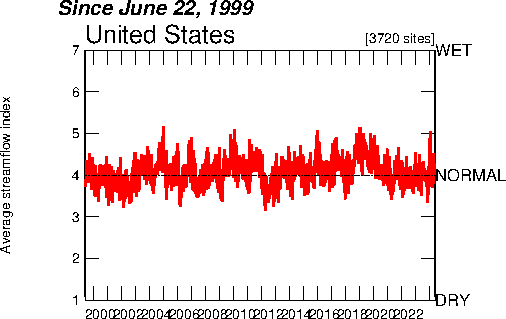
What about More WET or DRY... again, not much change here on data available

 Ok what about DROUGHT? From available data... not much correlation.

Now, what if we check the data source and plot all fires size and number of acres burned.  I had to extract the data from here and plot it myself, since it was not available.  The other thing is, that data starts in 2004 up to today.  So from this, you can see that there's a down trend on both Acres burned and number of fires.


From the NIFC, we can find the same data used by the union of concerned scientist on large fires but only from 1997.  Sorting through this and calculating trend, you can see this the following. So yes there seems to be a upper trend of total Acres Burned, but only on large fires and over that time frame, from 1997 to 2012.  When you look closely, you see that the 2012 bar is around the same as 2004, 2006, 2007and the 2011 bar is lower that 2002.  Not sure we can come to any clear conclusion based on this data and even less certain that we can link human CO2 to more forest fires.


Conclusion:

Always be very skeptical when you see "organization" jump to conclusions. Check the data, ask yourself lots of questions.  And above all, always remember that correlation does not mean causation.

For sure, forest fires are bad, people lose their properties, people are killed.  Many have their lives changed forever.  We definitely need more resources to this issue but jumping to conclusions that climate change is responsible for this and that we only need to cut fossil consumption and everything will be all nice and good, is not only misleading but irresponsible and only serves some agenda.

Remember this related to human CO2 (from my twitter feed)

samedi 28 septembre 2013

New IPCC report the other side of the story

We are now bombarded with one liner reports from the mass media like this one. Seems everybody is repeating the same mantra with almost no analysis whatsoever.

Climate scientists are 95% confident that humans are responsible for at least "half of the observed increase in global average surface temperatures since the 1950s." source

There's some much to be said about this report, but let me start by a couple of graphs.

First this one:
The IPCC graph shows that climate models predicted temperatures should have responded by rising somewhere between about 0.2 and 0.9 degrees C over the same period. But the actual temperature change was only about 0.1 degrees, and was within the margin of error around zero. source
You see from this how "mushy" the models are and how they do not track the real observed temperature of the planet.  In reality, the observed temperature change is not a big issue, but what the models show are.  But if we cannot rely on models, why are we believing in them so blindly?  In the words of Ross McKitrick here:
The IPCC must take everybody for fools
Here's some other graphs and sources on how the models are way off from reality.

source


 The above show how the models are running too hot.
source
The above is how 75 models compared with real observed temperature.

So who is the IPCC anyway?  The best video I have seen on this subject is embedded below (source)


What are the real life observations are showing?  You can play with the numbers yourself by clicking here. This graph shows the whole of the HADCRUT 3 unadjusted global mean temperature data set.  We can see that for the past 15 years 1998-2013 we have seen no increase in global temperature while the CO2 (blue line) kept increasing in a linear fashion. So if CO2 is driving the temperature rise, why have we seen a ZERO increase for 15 years?
When you look at this, always remind yourself that this is temperature anomalies.  To better understand what this is, please read this article.


It's interesting to see the real temperature swing.  Here's an example from Quebec City from 1978.  Can you see a temperature trend?  Compared this monthly average of around -15c to +15c or 30 degrees C with the above graph range of -0.2c to 0.6c or 0.8c (anomalies) for the same period.

You also have to note that this station is near a big city that probably saw the "heat island effect"

Another thing you have to consider, is the question of how much human made CO2 is in the atmosphere.  here's a quick video on that subject.


So has you see from the tip of the iceberg view on the climate debate... it's not that clear cut.


More sources of information

mardi 29 janvier 2013

Gentilly 2, exploitable pendant 5 ans?

Selon cet article, Gentilly 2 serait exploitable pendant 5 ans, sans réfection.  Donc un petit calcul s'impose!

La centrale peut produite 625MW, disons qu'elle opère à 80% pour les 5 prochaines années.Ceci nous donne... 625,000KW x 0.8 = 500,000KW de puissance!

Soyons généreux avec notre centrale et accordons le même contrat qu'Hydro à donné à Kruger, donc 10,55 cents/KWh.  Ceci nous donne 500,000x10.55cents = 52,750$ par heure d'électricité vendu... on multiplie par 24h et 365j et 5ans  = 2,310,450,000$

Donc on va perdre 2,3 milliard de dollars sur 5 ans?

Hum...

De plus, si on vendait cette électricité aux américains, il n'auraient pas à brulé du gaz de shale pour compenser... Ceci équivaut environ à 2,5 millions de tonnes de CO2 par années!  donc 12,5 millions de tonnes sur 5 ans.  Une auto moyenne émet 11,450 livres de CO2 par années, donc 12.5 millions de tonnes = 25,000,000,000 livres / 11,450 = 2,2 millions de voitures de moins sur la route (équivalence) si on roulait Gentilly 2 sur 5 ans!

Donc le PQ et les écolos, ont manqué le bateau complètement coté économique et écologique.

Évidement mes calculs sont grossier et rapide, mais même en coupant en deux les revenus et autres, c'est un investissement plus intéressant que la fermeture simple et rapide de la centrale.

Oh et une autre raison qu'ils nous disent pour fermer la centrale, les radiations c'est dangereux... Et bien, mes recherche me prouve le contraire... voir mon nouveau blog pour mes découvertes!

Commentaires?


samedi 21 avril 2012

Kony 2012, our education system and economic system.

You may have heard about the "Kony 2012" campaign?

Kony 2012 is the title of a campaign launched by the organization Invisible Children Inc., focused for now on the half hour video of the same name, which has had a viral diffusion on the internet reaching in a few days almost one hundred million views (it was published only on the 5th March). The campaign aims at supporting the arrest of Joseph Kony, an Ugandan guerrilla leader accused of “crimes against humanity” by the International Criminal Court (ICC) in The Hague.

It is clearly explained in many articles the doubtful aspect of this campaign and the possible connection of this organization to goals not at all related to saving children in Uganda.

We should save ALL the children and stop ALL those abuser of the world, but is this the solution?

Like Jean Ziegler explained in his latest book: Betting on Famine: Why the World Still Goes Hungry
Jean Ziegler, U.N. special rapporteur on the right to food, alerted the more than 500 delegates that while 854 million people went without food in the world last year, enough food was produced to feed 12 billion people. "This is why a child that dies from famine is murder," Ziegler said. The prices of corn, rice and wheat are literally exploding because of market speculation on the basic commodities.
So you see, there a more urgent problems in the world caused by the speculation on many things, the world economies are about to explode because of speculation out of control, why is the world focusing on this "campaign"?


Here's some samples articles from serious and reputable sources:

Beyond “Kony 2012”. What is Happening in Uganda? America's "Invisible" Military Agenda by Daniele Scalea
The United States has intervened in Uganda within the framework of increased militarization in its relationship with the continent, made necessary by the political and trading penetration of China in Africa.

The sending of military advisers to Museveni, possibly a prelude to military escalation (maybe what the Kony 2012 viral campaign wants to achieve?), is to be taken in conjunction with drone bombardments in Somalia, intervention in Libya to overthrow Gaddafi, French intervention in Ivory Coast to depose Gbagbo. Julien Teil’s documentary The Humanitarian War has shown the role, not too clear, of NGOs in preparing the ground for NATO intervention in Libya.

Invisible Children emphasizes the need to send US troops to Uganda at a time when the LRA seems weakened and, according to many people, Kony hasn’t been in the country for years. At this point it does not seem rash to include also Kony 2012 in the arsenal of US soft power that should support the spread – not necessarily in a peaceful way – of Washington’s influence in Africa.

Democracy now: Kony 2012: Ugandans Criticize Popular Video for Backing U.S. Military Intervention in Central Africa

The relationship between Invisible Children and the U.S. government and the Ugandan regime disturbed me a lot. And we started doing more investigation and more research, and that’s how we came out with the revelation that the U.S. ambassador to Uganda in 2009 had actually written a cable, which was revealed through WikiLeaks, in February 2009, indicating that Invisible Children had approached the U.S. embassy and made it known to them that they were going to be conducting campaigns that would advocate and promote the military solution. That was one of the memos.

A second memo, which was actually much more disturbing, said that Invisible Children had provided a tip to Ugandan intelligence services, leading to the arrest of a suspected regime opponent. This suspected regime opponent used to be a child soldier, as well, and had been taken under the care of Invisible Children and was, in fact, staying at one of their facilities in Uganda. He was arrested. And as many people familiar with Uganda know, people that are arrested by intelligence services in Uganda are subjected to torture. Subsequent to his arrest, nine other Ugandans were arrested, and now they face treason charges. And treason in Uganda is punishable by the death penalty.

So the relationship between Invisible Children does not seem to be independent. It seems to be involved in line with the U.S. administration and the Ugandan regime in advocating and pushing the military solution as the only approach, and disregarding the voices of Ugandans such as Bishop Odama, Bishop Ochola, who come from the war-affected region, who have been pushing the resumption of a negotiated solution to this war.
This web site: World Under Control - Helping to expose corruption by the global elite, one truth at a time: have many interesting links and article to debunk this campaign:


All this make me ANGRY and think that there is something wrong with our education system.  I have seen my local school and many kids involved in this campaigns using emotions in the movie to indoctrinate them.

You then wonder why are we here, why are so many of us "buy" this stuff without asking any hard questions, without being critical and skeptics?

Go read this article on education:
The Purpose of Education: Social Uplift or Social Control? - The Path to Deconstructing Democracy
Fichte laid it down that education should aim at destroying free will, so that, after pupils have left school, they shall be incapable, throughout the rest of their lives, of thinking or acting otherwise than as their schoolmasters would have wished.
Wake up people. There are better way of helping Africa.

mardi 31 janvier 2012

Toilette à composte... Bonne solution verte?

J'écoutais "la vie en vert" à Radio-Québec et le reportage du 31 jan 2012 sur les toilettes à composte. Curieux de nature, voici une petite analyse rapide.

  • La toilette chez home dépôt est vendu à 1565$
  • L'article parle de sauver 30,000 litres d'eau par années
  • Dans la même émission, on nous dit que chaque mètre cube d'eau (1000 lites) coûte 0,30$ à produir
Donc, 30,000 litres d'eau économisé divisé par 1000 litres pour 30 cents, ça nous donne 9$ d'économie par années, donc... 1565$/9$ =  174 ans pour rentrer dans notre argent... Hum, c'est long ça! Ceci ne tiens pas compte du coût pour traité les boues usées...

Par exemple, l'usine de Drummondville de traitement des eaux, peut traité 24,163,000,000 litres / année.  Une évaluation rapide, nous donne 7.1M$ par an en moyenne (Cout + opération) entre 1982 et 1999. Ceci nous donne un coût par 1000 litres traité de 0,30$ environ...

Donc pour traité 30,000 d'eau ça coûte 9$... donc 18$ d'économie... Donc on coupe à 87 ans notre retour sur investissement... Hum pas payant encore!

Je pense qu'il serait plus profitable pour tous d'installer des usines OHAP comme à Salaberry-de-Valleyfield.


Ce procédé possède plusieurs avantages par rapport aux autres méthodes de disposition des boues que sont la valorisation agricole, l'enfouissement, le compostage et l'incinération. Les principaux avantages sont les suivants :
  • C'est une solution finale complète, directement à la source
  • Élimination totale des risques sanitaires (pathogènes, virus, bactéries non digérées, etc.)
  • Encombrement des équipements minime et peut opérer de façon continue peu importe les conditions météorologiques.
  • Température d'opération basse donc moins de génération de NOx et moins d'entretien et remplacement des matériaux réfractaires
  • N'est pas assujetti aux variations du marché (e.g. coûts croissants de l'enfouissement, offre/demande du compost, etc.)
  • La récupération de la chaleur et des cendres permet leur valorisation
  • Procédé insensible aux caractéristiques physico-chimiques des boues (pH, concentrations de métaux lourds et autres substances toxiques).
  • C'est une technologie simple, efficace et fiable
  • Ne produit pas d'odeur
Il ne faut jamais oublier que pour chaque dollars dépensé au Québec, environ 0,62$ est dépensé en énergie fossiles.  Donc dépenser 1565$ pour une toilette, équivaut à dépensé 968$ en énergie fossiles... par très vert tout ça!

samedi 21 janvier 2012

La prochaine révolution verte

Prochaine révolution verte

Il existe déjà des solutions incroyables concernant la sécurité alimentaire avec l'agriculture verticale et l'aquaponie. Cependant, le temps que de telles technologies soient promues, qu'est ce que l'agriculteur moderne peut faire actuellement pour améliorer le rendement de ses terres tout en réduisant son empreinte écologique? Poussons un peu plus loin : comment pourrait-il également restaurer les terres dégradées par une exploitation trop massive de pesticides, des monocultures, et l'érosion prématurée des sols?

À l'heure actuelle, 40 % des sols du monde sont exploités par l'agriculture. La dégradation des sols menace la sécurité alimentaire à un point tel que les États-Unis sont passés de 2 ans de réserves en 1985 à seulement 43 jours en 2010. Le problème est préoccupant, mais effectivement, des solutions et des techniques existent. Si ces solutions étaient mises en application, nous n'aurions pas besoin de défricher davantage de forêts pour fournir une population croissante, mais pourrions produire plus sur beaucoup moins d'espace et restaurer les terres dévastées. Ces moyens ont déjà fait leurs preuves, et peuvent conduire à une plus grande prospérité.

Solution #1 : La permaculture

Le concept, inventé par Bill Mollison dans les années 70, est de recréer un écosystème autosuffisant par une symbiose de plusieurs espèces de plantes, d'insectes et de champignons. Geoff Lawton a prouvé au début des années 2000 qu'il est possible de reverdir le désert en Cisjordanie avec seulement un cinquième de l'eau nécessaire à l'agriculture par irrigation conventionnelle.

La technique consiste à creuser une tranchée qui récolte les retombées des pluies, assurant ainsi une réserve d'eau à longueur d'année. Sur chaque côté de la tranchée, des buttes couvertes de compost et de restes de cultures précédentes — qui auraient été brûlées normalement — sont reconverties en nutriments pour le sol. Des arbres fruitiers et autres types de cultures sont alors plantés en étages le long de la berge et irrigués par un système de compte-gouttes allant directement aux racines. À mesure que le temps passe, le sel emmagasiné dans le sol vient à être éliminé par des champignons et des insectes, rendant à nouveau le sol fertile. La terre, même après avoir été abandonnée pendant 5 ans par manque de fonds, a conservé toute sa vitalité. C'est ce qu'il a pu constater à son retour en 2009. Pour plus de détails, voici la vidéo qui relate l'épopée :


Voici un autre exemple de permaculture à l'œuvre, cette fois-ci par Willie Smits, qui en 4 années et avec la collaboration de plusieurs familles d'agriculteurs, a restauré une plaine quasi désertique en 500 acres de forêt amazonienne :


Sinon, certains préceptes de la permaculture ont été instaurés à l'agriculture de certains pays du tiers-monde. Cette technique, l'agroécologie, combine les propriétés de plusieurs plantes pour augmenter par 5 fois le rendement de l'agriculture de subsistance — si l'on se met dans le contexte que l'agriculture commerciale, augmente cette capacité de 10 fois. Mais c'est entièrement biologique, donc une bonne piste à explorer.


Solution #2 : Progrès technologiques et rendements optimisés

Voici comment une simple roue creusant des sillons semblables à une gaufre parvient à éviter l'érosion prématurée des sols et ceci sans compacter la terre tout en économisant l'eau bien répartie. Cette invention augmente l'efficacité d'un sol de 30 % selon les chiffres.


Sinon, la réorganisation des sols en modèle circulaire et une simple invention permet de pratiquer l'agrocircle, permet de réduire l'effort fourni par un simple agriculteur de 70 % en plus d'éliminer les émissions de gaz à effet de serre.
Irrigation au cœur du Sahara

 La vidéo est sous-titrée en anglais (cliquez sur cc).


Il est également prouvé par une étude de McGill que le rendement pourrait être optimisé si les cultures étaient adaptées selon les climats. Certaines cultures de maïs à travers le monde ne fournissent que de 20 à 40 % de rendement, alors qu'elles pourraient en fournir 100 %.

Solution #3 : Champignons et bactéries

L'agriculture industrielle utilise de nombreux fertilisants chimiques à base d'azote pour produire du nitrogène, ce qui a assuré le rendement commercial que l'on voit de nos jours. Même si jusqu'à maintenant nous avons pu nourrir la population mondiale actuelle (même au-delà si l'on comptabilise le gaspillage éhonté), cela n'a pas été sans aléas. Ces fertilisants, en se déversant dans nos cours d'eau, contribuent à la propagation des algues, ce qui cause des zones mortes pour la biodiversité.
Ce qui est important de trouver, ce sont de nouvelles méthodes pour améliorer le rendement des plantes, tout en capturant davantage de Co2 pour que les sols se régénèrent.

Eh bien!, n'ayez crainte, des recherches sont déjà en cours, avec des résultats pour le moins stupéfiants.

Les champignons contribuent largement à la conversion des matières organiques en nutriments pour le sol, et donc par intérim pour les plantes. Voici comment, avec l'aide de certains types de champignons, l'on pourrait revitaliser les sols dégradés, recréer des écosystèmes en laissant la nature se régénérer et créer des pesticides naturels en plus d'antibiotiques. Encore mieux, ces champignons pourraient être utilisés pour nettoyer les sols après un déversement de pétrole. Il faut le voir pour le croire. Ces recherches, effectuées par Paul Stamets, sont très prometteuses.


Mais, pourquoi se limiter seulement à des recherches alors que des résultats démontrent clairement une nette amélioration au rendement des cultures? Voici une vidéo de TED (comme de nombreuses autres précédemment), animée par Guy Webb, montrant des techniques qui favorisent l'extension des racines des plantes et utilisent des bactéries et champignons pour régénérer le sol en capturant le Co2. Ici, ils passent d'une capture de l'agriculture conventionnelle de 1,5 tonne de Co2 par hectare à 281 tonnes de Co2 par hectare... Ça donne à réfléchir.


En conclusion, certes, beaucoup de chemin reste à faire, mais ces découvertes ne sont que la pointe d'un iceberg de possibilités. Imaginez les progrès accomplis en à peine 20 ans. Imaginez une autre période de temps semblable, et la vitesse à laquelle notre technologie évolue. L'avenir ne sera pas aussi noir qu'on veut bien le laisser entendre. Au lieu de regarder un problème et de laisser quelqu'un d'autre s'en charger, au contraire, les mariages d'idées seront la panacée aux enjeux auxquels l'humanité devra faire face dans les années à venir.

Vincent Blanchette

lundi 2 janvier 2012

Climate debate at the Canadian Senate - Why Canada is out of Kyoto

A very important and interesting debate took place mid December 2011 on the climate, CO2, global warming. After listening to those very knowledgeable and serious researchers, it's easy to see why the Canadian government jumped off the Kyoto protocol.

Invitee list:

  • Ross McKitrick, Professor, Department of Economics, University of Guelph
  • Ian D. Clark, Professor, Department of Earth Sciences, University of Ottawa
  • Jan Veizer, Professor Emeritus, Department of Earth Sciences, University of Ottawa
  • Timothy Patterson, Professor of Geology, Department of Earth Sciences, Carleton University
Here's the full presentation on YouTube:


Other video in other languages are available here.

The transcripts will be available here.

Ross McKitric testimony available here.
Copied here for quick reference:

Testimony
For delivery to the Senate Standing
Committee on Energy, the Environment
and Natural Resources,
Parliament of Canada
Ottawa Ontario
December 15, 2011
Ross McKitrick, Ph.D.
Professor of Economics
College of Management and Economics
University of Guelph
Guelph Ontario Canada
ross.mckitrick@uoguelph.ca TESTIMONY: Senate of Canada, Ross McKitrick, December 15 2011

1. My name is Ross McKitrick, and I am a Full Professor of Economics at the University of
Guelph where I specialize in environmental economics. I have published on both on the
economics of climate change and statistical analysis in climatology. I was an expert
reviewer for the Intergovernmental Panel on Climate Change (IPCC) Fourth
Assessment Report, and in 2006 I was one of 12 experts from around the world asked
to brief a panel of the US National Academy of Sciences examining paleoclimate
reconstruction methodology.

2. The global warming issue is often described with emphatic claims that the “science is
settled”, the situation is urgent, and the necessary actions are obvious. The reality is
that there are deep disagreements about underlying scientific issues, there is reason to
believe the problem has been exaggerated, and most  policy proposals simply do not
pass objective cost-benefit tests. Amidst the disputes and controversies of the past few
years, I believe two points have emerged with clarity.

3.  First, the economics of climate change do not favour Kyoto-type commitments. Under
current and foreseeable technologies, the greenhouse gas policies we can afford to
undertake would have such small climatic impacts as to be pointless. The same kinds of
models that are used to forecast global warming predict that, if all signatories to the
Kyoto Protocol complied with their commitments, the level of carbon dioxide (CO2) in the
atmosphere that we would have observed by 2100, would instead have been reached by
about 2105, a trivial difference. And Kyoto was too costly for countries to reach. When a
policy is proposed that is too costly to implement and yields benefits that are too small to
measure, you would expect reasonable people to see  it as a bad idea. Instead we
observed a dogmatic elite consensus emerge in support of Kyoto. In my mind this never
validated Kyoto, it merely discredited the elite consensus, and suggested to me that the
international political milieu in charge of the climate issue was unduly susceptible to
groupthink.

4. Unlike such air pollutants as sulphur dioxide and particulates, CO2 is not easy to
capture, and once captured, there is no obvious way to dispose of it. There appears to
be no way to cut CO2 emissions on a large scale without cutting energy consumption
and impeding economic activity. Despite their enthusiasm for embracing targets,
policymakers around the world have not been able to cut CO2 emissions while pursuing
economic growth. Simply put, with regard to climate policy, the cure is worse than the
disease.

5.  Second, the official process for assessing technical and scientific information on climate
change for the purpose of advising policymakers has become untrustworthy due to bias
and partisanship. As a member of the expert review team for the last IPCC Report, I
saw things take place that violated longstanding principles of peer review. I documented
some of them in various publications since 2007, but the issues never received much
attention until the fall of 2009, when thousands of emails from top IPCC scientists were
leaked onto the internet. The so-called Climategate emails confirmed the reality of bias
and cronyism in the IPCC process. The new leaks last month provided even more
confirmation that climate scientists privately express greater doubts and disagreement
about climate science than is reflected in IPCC reports.  TESTIMONY: Senate of Canada, Ross McKitrick, December 15 2011

6. Earlier this year I was asked by the London-based Global Warming Policy Foundation
to review IPCC procedures, and to make recommendations for reform. My report was
published last month, and includes a foreword written by John Howard, the former Prime
Minister of Australia. I have included a copy with this submission. I mainly focus on how
the IPCC handled issues with which I have first-hand knowledge as a contributor to the
peer-reviewed literature on the subject, and on which I worked closely on the IPCC text
in my capacity as an expert reviewer.

7. The IPCC is not a neutral observer of the scientific process, instead it has a party line. It
is controlled by a relatively small Bureau in Geneva, consisting of a small core
surrounded by a network of supportive academics and government officials. The
oversight body, called the IPCC plenary panel, is passive, inattentive, and overly
deferential to the Bureau. In effect there is no oversight.
8. The Bureau picks Lead Authors who share their views. They are routinely placed in the
position of reviewing their own work and that of their critics, and are free to rule in their
own favour. Lead Authors are also free to reject reviewer comments, over-ride Review
Editors, and even rewrite text after the close of the peer review process. The
combination of Bureau control over the selection of Lead Authors, and a toothless peerreview review process, means that IPCC Assessments are guaranteed merely to repeat
and reinforce a set of foregone conclusions that make up the party line.

9. In my report I document some disturbing cases where the IPCC violated proper peer
review practises. These include:
• Manipulating prominent graphs so as to conceal known flaws in the statistical basis
of paleoclimate reconstructions and to exaggerate evidence that modern climate
change is historically exceptional. This is the so-called “hide the decline” scandal.
• Fabricating a statistical test result to provide a rationale for dismissing published
evidence of urbanization-related contamination of the surface temperature record on
which key IPCC conclusions were based.
• Waiting until the close of peer review, then removing text that had initially, and
correctly, cautioned readers that the IPCC method of calculate warming trends likely
exaggerated their significance, and replacing it with unsupported text saying the
opposite.

10. My report documents these and other incidents that, in my view, suffice to discredit its
claims to rigour and objectivity, and point to the urgent need for procedural reform.

11. In 2010 The InterAcademy Council reviewed IPCC  procedures and drew attention to
many of the same problems as my report does. Unfortunately the IPCC’s internal reform
process has gone nowhere. I discuss this problem in Section 4 of my report.

12. At this point we could simply muddle along for  another 20 years enacting more and
more costly and wasteful schemes based on the increasingly biased and unreliable
guidance of the international climate policy milieu. That would be the easiest course of TESTIMONY: Senate of Canada, Ross McKitrick, December 15 2011
action, but would not serve the public interest. The more difficult option would be to
begin the hard work of improving the decision-making process itself, beginning with
reform of the IPCC.

13. My published research has led me to believe that the IPCC has overstated the global
warming issue. I have shown that the spatial pattern of warming trends in the surface
temperature record is strongly correlated with the  spatial pattern of industrialization,
even though this pattern is not predicted by climate models as a response to
greenhouse gases. This indicates that the standard climate data sets likely have a warm
bias due to their failure to correct for disturbances of the land surface from urbanization,
agriculture, and so forth.

14. I have also shown that climate models predict significantly more warming over the past
30 years in the tropical troposphere than is observed in satellite or weather balloon
records. This is a key region for measuring the water vapour feedbacks that control the
magnitude of greenhouse warming. Despite this being the region that models say
should be warming fastest in response to greenhouse gases, the 50-year balloon record
actually shows no positive trend once the effect of ocean circulation changes in the late
1970s are removed from the record. One of the most  telling emails in the so-called
Climategate 2.0 archive that was just released last month involves one IPCC expert
warning another that their efforts to finesse this issue by deceptive trend analysis is a
“fools paradise.”

15. Today you have a chance to hear from a number of serious Canadian scientists about
work that they and their colleagues have done that also calls into question aspects of
the IPCC party line.  The fact that you have learned little of what they are about to tell
you does not indicate any deficiencies in the research they or their colleagues have
done. Instead it points to the deficiencies in the  process that was supposed to have
brought this information to your attention long before now.

vendredi 30 décembre 2011

It's the end of the world... Again... Hum...

Today, December 30th 2011, we read this propaganda piece in "The Gazette" and distributed, without analysis by Radio-Canada on twitter.

They did not even copied the right information. 2018 or 2020... It's important to get the end date right ;-)


ABOVE-AVERAGE TEMPERATURES WERE RECORDED DURING EVERY SEASON OF 2011. And while winter-weary Quebecers might welcome the warmer weather, it sends a more sinister message to scientists who see it as evidence that, by 2020, temperatures in Quebec will exceed the 2-degree tipping point they say will lead to catastrophic climate change. William Marsden reports, Page A3. WHAT KIND OF ENERGY IS QUEBEC USING - and what does it need? Our appetite will fuel debate in 2012, Lynn Moore writes. Page B1
Couple of points to note when you read this:
  • Above average temperatures..
    • Which data set did they take?  There are so many out there, without this vital information, it's hard to know what they are talking about.
    • Here's a graph of all data set for the last 10 years...
  • "evidence that, by 2020, temperatures in Quebec will exceed the 2-degree tipping point"
    • Evidence?  By 2020?, what data set extrapolation did they used?  What models?  Why 2 degrees?  All those are assumptions, extrapolations, based on mathematical models often unproven and unable to track real life data set.
  • lead to catastrophic climate change
    • Catastrophic climate change!!! Wow, 2 degrees more would be a catastrophe, if this ever happen, what are the proof that this will be a catastrophe, continue reading... we have seen worst in the past.
  • The rest of the small article, last 2 lines, does not make sense at all... No references provided on the web page of the Gazette.
I classify this small article as pure propaganda... When I read this I think of Mulder in X-files... I WANT TO BELIEVE!

Here's some real information that can help you to judge by yourself, if you are not the type that does believe everything that the mass media throws at you!

In all the data set, I think in my humble opinion that the more precises/accurate is the UAH dataset that started in 1978 and is based on microwave sounding units on polar orbiting satellites. Here's all the data since it started.  I plotted a green line for a running average of 13 months.  I also plotted two regression lines before and after the mount Pinatubo event.  Do you see in there a maximum average temperature higher than other years?  You also need to note the range of change since 1978, that is for that last 33 years...


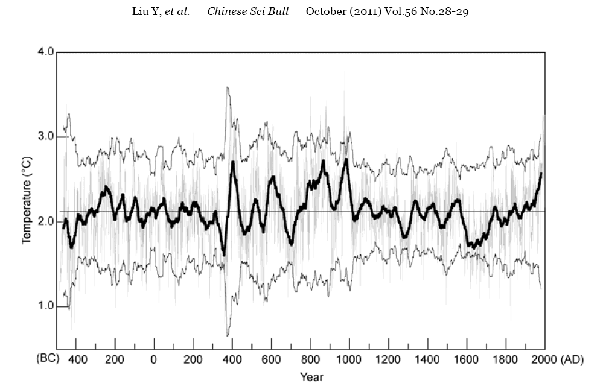
But today's temperature data need to be put in perceptive on a longer time scale... Here's a study of the last 2485 years in the China region, it clearly shows that the temperature in the past was higher then today, if the tipping point theory was right, we should have seen a couple of time a run-away temperature on the planet where the planet would have burn to a crisp!  But if you read on this term "tipping point" it's not even clear what it means!.
Tree-ring-based temperature reconstruction for the central-eastern Tibetan Plateau during the past 2485 years (gray line), the 40-year moving average (thick black line) and the 40-year running standard deviation (thin black line); the horizontal line is the mean temperature for the 2485 years.

Here's another study for that last 4000 years in Greenland... As you see, many time, again, the climate was warmer.
Past 4000 years of
Greenland temperature. Thick blue line and band are the same as above. Thick green line represents 100‐year moving
averages. Black and red lines are the Summit [Box et al., 2009] and AWS [Stearns and Weidner, 1991; Shuman et al., 2001;
Steffen and Box, 2001; Vaarby‐Laursen, 2010] decadal average temperature, respectively. Blue and pink rectangles are the
periods of 1000–2010 C.E. (Figure 1, middle) and 1840–2010 C.E. (Figure 1, top), respectively. Present temperature is
calculated from the inversion adjusted AWS decadal average temperature (2001–2010) as −29.9°C
From Wikipedia, I highlighted in red what I think is missing in most climate related journalism reports.

The elements of journalism

According to The Elements of Journalism, a book by Bill Kovach and Tom Rosenstiel, there are nine elements of journalism.[2] In order for a journalist to fulfill their duty of providing the people with the information, they need to be free and self-governing. They must follow these guidelines:
  1. Journalism's first obligation is to the truth.
  2. Its first loyalty is to the citizens.
  3. Its essence is discipline of verification.
  4. Its practitioners must maintain an independence from those they cover.
  5. It must serve as an independent monitor of power.
  6. It must provide a forum for public criticism and compromise.
  7. It must strive to make the news significant, interesting, and relevant.
  8. It must keep the news comprehensive and proportional.
  9. Its practitioners must be allowed to exercise their personal conscience.
In the April 2007 edition of the book,[3] they added the last element, the rights and responsibilities of citizens to make it a total of ten elements of journalism.


So when you read stuff in the mass media, ask yourself a couple of question and always be skeptical!  Your way of live and of future generations may depend on it.

dimanche 6 novembre 2011

Nuclear power is EXTREMELY dangerous, but compare to others, EXTREMELY safe!


As of March 2011, Naval Reactors have run 6300 reactor-years, driving 528 reactor cores on 220 ships over 145,000,000 miles without a single radiological incident  or injurious radiation exposure to crew or public.  Because of the shielding from the hull and the seawater, crews at sea generally get less radiation, living within 100 meters of an operating nuclear reactor, than their families at home.  All of the radiological information about the ships and associated shore facilities is released to the public in documents in which the detailed data are accumulated without a break since 1954.

With respect to the international nuclear power industry at large, John Ritch, the Director-General of the World Nuclear Association, made the following statement to the science editor of station NDTV on 24 October 2011:  “Perhaps I would think this problem is more serious if we had been besieged by many large fatality accidents in nuclear power. But I think I am correct in saying that in fourteen thousand five hundred reactor-years of civil nuclear power production we have not seen a fatality apart from the limited number of deaths that occurred as a result of the Chernobyl accident...Very few industries have produced such beneficial results with such an extremely low toll of damage to the environment or the public.  This industry has an amazing record of safe performance and beneficial contribution. That basic fact is much too little appreciated by the public.”

During the same period, the following non-nuclear accidents occurred:

Banqiao Dam Failure:  One of 62 hydroelectric dams in Zhumadian Prefecture in China that failed catastrophically or were intentionally destroyed in 1975 during Typhoon Nina.  An estimated 172,000 people were killed, 11 million people lost their homes, and about one-third of the electric power capacity of the national grid was destroyed.  The resulting damage to the farmland is not reported.

Bhopal Pesticide Factory Release:  A leak of methyl isocyonate gas from a Union Carbide pesticide plant in Bhopal, Madhya Pradesh, India in 1984 led to 558,125 injuries, including 38,478 temporary and partial, and 3900 severely and permanently injured.  An estimated 3000 died within weeks and another 8000 have since died from the incident.  Some believe these official estimates grossly understate the situation.

Deaths from Coal:  From coal’s air pollution alone, there have been 30,000 deaths per year in the US, 500,000 per year in China.  These figures do not include deaths of coals miners, the destruction of stream beds destroyed by pushing mountain-tops into stream beds, the effect of mercury and other toxins on fish, etc.

BP Oil Spill:  The environmental and health impact of this event has not been estimated.  And there are many other spills that have received little attention. The fact is that it is simply not true that nuclear radiation is uniquely hazardous, even when totally uncontrolled releases occasionally occur.

Another fact is that unwarranted fear of harmless levels of radiation has caused unprecedented damage.  People are afraid to return to their homes and businesses.  They’ve terrified themselves, their friends and their children.  The health effect of such widely enforced terrorism is itself devastating.  The effect on the economy is paralyzing.  

In Fukushima, amid thousands of non-nuclear deaths, international investigation under IAEA concluded: "To date no health effects have been reported in any person as a result of radiation exposure from the nuclear accident" But the Government is concerned about letting people return to their homes.

There is no defensible scientific basis for discouraging people from living where radiation levels are “high,” when they are still lower than the highest natural radiation levels in Iran, Brazil, Norway, India, China and other regions where people have dwelt healthfully for countless generations with backgrounds hundreds of times higher than deemed “permissible.” 

More fundamentally, why should radiation level be the prime consideration as to where and how one chooses to live?  Many people make decisions that increase their radiation dose many-fold by moving to mountainous regions, or by cladding their houses in brick or stone, or by visiting radioactive health spas.  By what authority do the radiation protection police have their particular concern outrank all others?  Are we going to let them strip the natural soil off the ground in Japan, to lower the radiation background to some arbitrary number?

Why should we fear “nuclear waste”?  The only way it can harm anyone is if it is eaten.  It is not in soluble form, so we store it in shielded cans until it is needed to be recycled as fuel in a reactor designed for that purpose.  This is not difficult; the process has been demonstrated, but it Is currently cheaper to just store the used fuel until needed.  Non-nuclear industry produces millions of times more lethal doses of other poisons.  The main difference is that the nuclear material gets less toxic every day, and after a few hundred years, becomes no more toxic than some natural ores.  But the non-nuclear wastes maintain full toxicity forever.  Fukushima and 9/11 have shown that we should design the plants to perform under even more extremes of conditions, and these improvements have been underway in America since immediately after 9/11.

Putting radiation numbers in perspective:
Marshall Brucer, “the father of nuclear medicine,” in his canonical Chronology of Nuclear Medicine,shows how widely radiation backgrounds vary.  On page 323, he lists various radiation background levels (with cosmic ray contribution removed) from New York City at 0.62 mSv/year to SW France up to 876; to the potash fertilizer area in Florida up to 1750.  He notes, “If you live in one place on earth, your background may vary from day to day by a factor of ten, or even 100…The inside exposure rate can change by a factor of 10 within hours, just by opening windows.”  He notes that building with brick, rather than wood, can nearly double your daily radiation dose, but that the radioactivity of  bricks and concrete is also highly variable: from 0.05 to 4.93 mSv/yr for bricks, and from 0.29 to 25.4 for concretes.  “A factor of 10 daily variation [in radiation dose] marks the diets of most people.”  [mR in original, converted here to mSv]
People have lived healthily for millennia with natural radiation up to following mSv/yr:
Ramsar, Iran (260), Kerala, India (35), Guaripari, Brazil (35), Yangiang, China (5.4)


Other article on nuclear power and radiation:
Comments?

vendredi 28 octobre 2011

Population to reach 7 billions this year

Population growth going down everywhere.


Also fertility rate.


Good article:
The world’s population will reach 7 billion at the end of October. Don’t panic

vendredi 14 octobre 2011

De bonne idée pour le transport en commun au Québec.


Le Monorail TrensQuebec comme entreprise nationale de transport.
http://www.trensquebec.qc.ca/

Building a modular nuclear power plant in a 11 weeks!

Looking at what we accomplish in the 1960's, we wonder why today it takes 10 years and billions to build a nuclear power plant?

In seventy-seven days, the Army team assembled the prefabricated reactor. Just nine hours after fuel elements containing forty-three pounds of enriched Uranium-235 were inserted into the reactor, electricity was produced.

WARNING: STRONG POLITICAL VIEW IN THIS VIDEO.


More info:
The US Army Nuclear Power Program was created to develop small nuclear power reactors for use at remote sites. Most were based on existing US Naval reactor designs. Eight reactors were built in all, and six of the eight produced useful power. The nuclear reactor at Camp Century was the first of the US Army's portable reactors to actually produce power.

The portable nuclear power plant at Camp Century was designated PM-2A. Its designation indicates: “P” for Portable; “M” for Medium Power; “2” for the sequence number; and the letter “A” indicates field installation. The PM-2A was rated two megawatts for electrical power and also supplied steam to operate the water well. The PM-2A was built by Alco Products, Inc. of Schenectady, New York. The USNS Marine Fiddler transported the reactor from Buffalo, New York to Thule Air Base in Greenland, arriving on July 10, 1960. Up to this time, it was the most valuable cargo ever shipped out of the port of Buffalo. In addition, the Army flew one of the three blast coolers to Thule on a C-124 Globemaster to demonstrate the practicality of air transport. Four hundred tons of pipes, machinery, and components were then carefully transported over the ice in twenty-seven packages. Special care was taken not to damage the parts, since intensely cold metal can become dangerously brittle. As a credit to superb packaging, a ceramic top to a lab cabinet was the only item damaged during transport.

In seventy-seven days, the Army team assembled the prefabricated reactor. Just nine hours after fuel elements containing forty-three pounds of enriched Uranium-235 were inserted into the reactor, electricity was produced. It was soon discovered that additional shielding would be necessary. This shielding was accomplished by adding a layer of two inch thick lead bricks to the primary shield tank. Except for downtime for routine maintenance and repairs, the reactor operated for thirty-three months, until July 9, 1963, when it was deactivated pending a decision to remove it. This decision stemmed from plans to discontinue year-round operations at Camp Century to reduce costs. In addition, the tunnel support structure sheltering the reactor was suffering from reoccurring damage due to compacting snow. A conventional diesel powered plant would have consumed over one million gallons of fuel over the same period. While the power plant was designed to provide 1560 kilowatts of power, Camp Century's power needs peaked at 500 kilowatts, and gradually declined from there. During the reactors operational life, a total of 47,078 gallons of radioactive liquid waste was discharged into the icecap. The PM-2A was removed in the summer of 1964 by the 46th Engineers based at Fort Polk, Louisiana. No military service was willing to accept the plant at another location so the PM-2A's components were put into storage. The reactor vessel was subjected to destructive testing in order to study neutron embrittlement of carbon steel. Phillips Petroleum Company conducted the testing for the US Atomic Energy Commission in 1966. After extreme testing, it was found to be much more durable than expected. Failure of the vessel finally occurred at minus twenty degrees Fahrenheit and 4,475 pounds per square inch pressure after hydrochloric acid was added to a machined defect.

vendredi 7 octobre 2011

GreenPeace: Anti Science, Fear, Anti Nuclear, Climate Alarmists

Following some story about greenpeace... Click on the links for the full stories.

Patrick Moore: From Greenpeace Dove to Nuclear Power Phoenix
Summary

If energy, food and education are the building blocks of civilization, Greenpeace Cofounder Patrick Moore is using his role of "sensible environmentalist" to build support for the concept of sustainable power generation. In this exclusive interview with The Energy Report, Patrick proposes that industry and government work together to advance nuclear power in the United States as the most effective way to supply continuous energy to homes, businesses and institutions.
Excerpt
They [GreenPeace] are more aptly described as political or social activists, which is fine in its own right, but when you are starting to deal with complex issues of chemistry and biology, you do need a little grounding in science in order to make good decisions.
Greenpeace tended to take a more black-and-white approach to many of these issues, and today they are opposed to all nuclear energy, even though it's a safe and clean alternative to fossil fuels. They are opposed to genetic engineering even though this could help eliminate micronutrient deficiency or malnutrition around the world. They are opposed to sustainable forestry, even though it's the most renewable resource in the world. They are opposed to farming fish in the ocean, which is a way of taking pressure off of wild stocks, which are overfished.
I think we made the mistake of lumping nuclear energy in with nuclear weapons. Our original campaign was against nuclear war, and we painted everything nuclear as evil. Today that makes no sense at all to me. Nuclear medicine is obviously not evil. Those nuclear isotopes used in nuclear medicine are created in nuclear reactors. That's one of the things we can do with nuclear technology. Another one is to make energy that's clean and safe. 

Why is the New York Academy of Sciences allowing its name to be used in an anti-science FUD campaign?
Summary:
Greenpeace wrongly used a published volume from the NYAS (New York Academy of Sciences) to support unproven claims that close to 1 million people died from the Chernobyl disaster. The real number of deaths directly attributable to the materials released by the accident will end up to be very close to 50.
Excerpt
Greenpeace claims that “based on now available medical data, 985,000 people died as a result of the Chernobyl disaster.” The authority for this statement is “the book recently published by the New York Academy of Sciences.” That death-toll is not supportable by scientific evidence.
A 2005 review of the data by an informal group call the Chernobyl Forum, included a suggestion that, based on the LNT premise (that even a single gamma ray could cause a cancer), 4000 additional deaths might ultimately occur. Since there is no indication that these deaths are likely, and since “prediction” of deaths by adding up of thousands of small individual radiation doses has been repeatedly forbidden as scientifically unsound, the suggested 4000 deaths has not been widely accepted.

Greenpeace’s Fear Machine

Summary:

Art Horn, writing at the Energy Tribune, calls our attention to a Greenpeace document titled The Climate Time Bomb. It was written 17 years ago – in 1994 – but it may as well have been yesterday.
The dramatic language, the glass-is-always-half-empty perspective on the world, the blind faith in the Intergovernmental Panel on Climate Change (IPCC) – it’s all there.
Excerpt:
One of the more distressing parts of that 1994 Greenpeace report is the section on human health. It’s important to remember that the IPCC’s first health chapter didn’t appear until 1995. It was so badly botched that Paul Reiter, who has devoted his entire professional life to the study of diseases spread by mosquitoes – including malaria – later described it as “amateurish.”Nevertheless, in 1994 Greenpeace just knew that climate change would lead to more disease. Its report includes a closeup photo of a person with a large open sore on their face, and declares that: 
Our health is threatened by climate change. Malaria, asthma, encephalitis, tuberculosis, leprosy, dengue fever and measles are all expected to become more common.
How does Greepeace know this?
  • because Australian officials “believe hotter summer temperatures may be contributing” to an increase in malaria
  • because US researchers think the discovery of a new strain of mosquito suggests that these mosquitoes “may spread rapidly in a global warming world” 
  • because a UK government report “suggests that malaria and other tropical diseases, and even bubonic plague, could be reintroduced to the UK as a result of global warming.
This is all that Greenpeace requires. Beliefs and suggestions – nothing more. Greenpeace is happy to take mere possibilities and translate them into the confident statement that Our health is threatened by climate change. It feels no shame in adding a lurid photograph which, one supposes, is intended to imply that we’re all fated to become disfigured if we don’t get with the Greenpeace program.

dimanche 2 octobre 2011

Cristina Fernández de Kirchner, opening statment of the Atucha II Nuclear Power Plant.

It's quite rare these days to witness those speeches by a leader.

Listen to Cristina Fernández de Kirchner, president of Argentina, on the opening of a nuclear power station.

Topics in one speech on:

  • Nuclear power
  • Sovereignty rights of a nation
  • Putting an end to debt with the IMF preventing the development of a nation
  • Restructuring the debt of a sovereign nation
  • Workers being the custodians of nation sovereignty
  • Nuclear power being the most important bastions of technological development
  • Foreign interference preventing preventing a nation from having nuclear power
  • A nation govern by itself


More info:

Attucha nuclear power:
http://en.wikipedia.org/wiki/Atucha_II_Nuclear_Power_Plant

Cristina Fernández de Kirchner:
http://en.wikipedia.org/wiki/Cristina_Fern%C3%A1ndez_de_Kirchner

How the IMF Sank Argentina
http://www.commondreams.org/views02/0127-03.htm

Terranova, can we do better?

There's a new show on TV.  


Terranova: another doom and gloom, end of the world scenario where the show start with a view on a polluted city, people with mask to breathe and a population control coops kidnapping the third kid of a family, because it's outlawed to have more than 2. The kids never saw an orange or clouds.. give me a break!

In the year 2149, the planet Earth is a disaster, and most of the plant and animal life has become extinct. Scientists can't reverse the
 damage, but have found a way to travel back to prehistoric times to save the human race.

I am so tired of those shows where humans can only do bad things and the only solution is to go back and live like crazy, unlawful armed farmers.

For starter overpopulation is a myth.. see:

Secondly, we know that by bringing wealth and education to population, their growth rate stabilize.

Third, we know that better technology, cleaner power sources, gives us a cleaner air.  The only task left for humanity is to move from coal power to nuclear power. From what I know, people downtown England breath better today then when they where burning coal in houses.

So I don't believe in those dooms day scenarios, humans are better than that, period.


dimanche 25 septembre 2011

Low level radiation and Linear no threshold (LNT) theory. We should revisit our regulation.

We should revisit our exposure regulations because our regulatory history is founded on a deception.
Some background first.
What is radiation? According to wikipedia:
In physics, radiation is a process in which energetic particles or energy or waves travel through a medium or space. There are two distinct types of radiation; ionizing and non-ionizing. The word radiation is commonly used in reference to ionizing radiation only (i.e., having sufficient energy to ionize an atom), but it may also refer to non-ionizing radiation (e.g., radio waves, heat or visible light).

So what concerns this article will be about ionizing radiation. Again from wikipedia:
Ionizing (or ionising) radiation is radiation with sufficient energy to remove an electron from an atom or molecule. This ionization produces free radicals, atoms or molecules containing unpaired electrons, which tend to be especially chemically reactive.

Low level radiation.
We know for sure that high level radiation will kill and we know fore sure that low level radiation does not. High level radiation from a nuclear bomb or exposure to high level of radioactivity from a close source of radiation will kill you from anywhere from an instant to a few days, depending on the amount you receive.

The not so clear debate is with low level radiation. Some argue that there is no safe limit where radiation is safe. Those are the advocate of the Linear no threshold theory or LNT.

There is another school of thought that understand that low level radiation under a certain level is safe and even goes further to say that it can also be beneficial. This is called Hormesis. The theory say:
Low levels radiation, activate the body's DNA repair mechanisms, causing higher levels of cellular DNA-repair proteins to be present in the body, improving the body's ability to repair DNA damage.

Sources of radiation in our day to day life
Radiation is everywhere. From the beginning of the earth to now, we are surrounded in radiation 24 hours per day. Here's the distribution of radiation we absorb every day for different sources.

Source of the information, copy here.

We even have natural radioactivity inside our body in the form of Pottassium-40, from wikipedia:
Potassium-40 is the largest source of natural radioactivity in animals and humans. An adult human body contains about 160 grams of potassium, hence about 0.000117 x 160 = 0.0187 grams of 40K; whose decay produces about 5,000 disintegrations per second (becquerels) continuously throughout the life of the body.
Basic conclusion:
So we are ourselves radioactive and we live in a natural environment immersed in radio-activity.  looking only at those obvious natural sources, we could conclude that humans and animals evolved with radioactivity and "learned" to adapt to it.  We could say that radioactivity is helping our immune system to better cope with external influence and keep our body functioning. We could also conclude that without a minimum level of radioactivity, we would be missing the benefits of keeping the immune system "in shape" and have negative consequences from it.  The same way that to be healthy we need to exercise, our immune system need the exercise provided by this low level radiation.

What level of radiation is OK?
I documented in August 2011 that within a certain range, there is a bio positive impact from radiation and outside that range, the impact is negative, since the immune system is either "sleeping" or overwhelmed.

From the conclusion we saw in the previous sections, this graph seems logical. We live in a radioactive environment, therefore we are between point 2 and 5 of this graph, but according to my investigation, we are closer to point 2 than point 4 (optimum), thus we do not have enough radiation to have the full "benefit" of it.  There are events that happened in the past, where we saw that higher than the "normal - closer to point2" level of radiation, where beneficial.

1984 - Taiwan cobalt-contaminated steel
An extraordinary incident occurred 20 years ago in Taiwan. Recycled steel, accidentally contaminated with cobalt-60 (half-life: 5.3 y), was formed into construction steel for more than 180 buildings, which 10,000 persons occupied for 9 to 20 years. They unknowingly received radiation doses that averaged 0.4 Sv—a “collective dose” of 4,000 person-Sv

Studies 20 years later showed that the cancer rates of this population was lower than the unexposed population in the same region.

This shows that this population, exposed to higher level of radiation, but within a limit that the immune system could cope with, got a long term benefit of having an immune system more in "shape" and able to kill off cancer cells as they grew old.

Today's regulation on low level nuclear radiation.
We now have evidence that the "linear no threshold" (LNT) of low level radiation as no scientific proof and all regulation that we have now are not based on sound science.

Here's a copy of an article published in Science News on Sept 20, 2011. Highlights added

No Safe Level of Radiation Exposure? Researcher Points to Suppression of Evidence On Radiation Effects by Nobel Laureate:

University of Massachusetts Amherst environmental toxicologist Edward Calabrese, whose career research shows that low doses of some chemicals and radiation are benign or even helpful, says he has uncovered evidence that one of the fathers of radiation genetics, Nobel Prize winner Hermann Muller, knowingly lied when he claimed in 1946 that there is no safe level of radiation exposure.
Calabrese's interpretation of this history is supported by letters and other materials he has retrieved, many from formerly classified files. He published key excerpts this month in Archives of Toxicology and Environmental and Molecular Mutagenesis.
Muller was awarded the 1946 Nobel Prize in medicine for his discovery that X-rays induce genetic mutations. This helped him call attention to his long-time concern over the dangers of atomic testing. Muller's intentions were good, Calabrese points out, but his decision not to mention key scientific evidence against his position has had a far-reaching impact on our approach to regulating radiation and chemical exposure. 
Calabrese uncovered correspondence from November 1946 between Muller and Curt Stern at the University of Rochester about a major experiment that had recently evaluated fruit fly germ cell mutations in Stern's laboratory. It failed to support the linear dose-response model at low exposure levels, but in Muller's speech in Oslo a few weeks later he insisted there was "no escape from the conclusion that there is no threshold." To Calabrese, this amounts to deliberate concealment and he says Stern raised no objection. 
Calabrese adds, "This isn't an academic debate, it's really practical, because all of our rules about chemical and low-level radiation are based on the premises that Muller and the National Academy of Sciences' (NAS) committee adopted at that time. Now, after all these years, it's very hard when people have been frightened to death by this dogma to persuade them that we don't need to be scared by certain low-dose exposures." 
Within a year after Muller and his group persuaded the NAS to accept the linear model for gonadal mutations, the practice was extrapolated to somatic cells and cancer. Twenty years later, NAS adopted the linear approach for chemicals. Soon thereafter, the U.S. Environmental Protection Agency announced it would use the linear model for risk assessment, Calabrese points out. 
Some can accept that even the most distinguished scientists have human failings, he acknowledges. But his view is that "the regulatory research community needs to hear about this. The implications of my findings are that we should revisit our exposure regulations because our regulatory history is founded on a deception. We have seen literally hundreds of thousands of cleanup decisions based on a model that was fraudulently derived. I think we should probably have drastically different exposure standards today, and far less fear."
Calabrese believes, "The die was cast by Muller and regulations adopted since then have gone unchallenged. I think he got his beliefs and his science confused, and he couldn't admit that the science was unresolved. So he went ahead and expressed an opinion about how to handle the public health situation." 
Geneticists in the 1950s came to embrace the "linear dose-response model" of risk because at the high exposures they tested, there was no level below which DNA damage did not occur. They felt medical doctors didn't grasp how significant were the dangers. As the smartest and brightest, Muller anticipated the risk of atmospheric atomic testing and became passionately committed to protecting society, Calabrese explains. 
Muller and Curt Stern had done many of the key experiments. Muller himself served on the NAS's Biological Effects of Atomic Radiation (BEAR) committee, through which the linear dose-response approach to risk assessment became firmly entrenched. The two successfully suppressed last-minute evidence from the fruit fly experiment conducted in Stern's lab by postdoctoral researcher Ernst Caspari, and the rest is history, Calabrese says. It marked the "transformation of a threshold-guided risk assessment to one now centered on a linear dose-response." 
"To me this all raises the question, what happens when a scientific field lies to the public, to federal agencies and the president? It's a very scary situation that the radiation genetics community in the 1950s assumed that something was correct without requiring the necessary documentation to support it," the UMass Amherst toxicologist says.
Stern's group published a paper in 1947 not long after Muller's Nobel Prize acceptance speech in which they tried to discredit their own study, further evidence of a deliberate cover-up, Calabrese says. "It's been hidden in the bowels of the Atomic Energy Commission for decades until I found it. They revised it to remove the one sentence suggesting this experiment might provide evidence for the threshold model." 
"One could argue that Muller single-handedly undermined above-ground atomic testing, which is a good thing," Calabrese says. "But after uncovering this lie, I'm starting to contemplate what society would have looked like if the regulatory community had felt free to use a threshold model. Members of that 1956 NAS BEAR committee didn't see the domino effect of their actions on our society. Muller's impact on the world of today is almost incalculable. He couldn't have imagined it. But we shouldn't have to live with it."
What are the impact of this regulation, not based on real impact of low does radiation?
The impacts are too numerous to count, but some come to mind.
  • Fukushima nuclear plant fear and exclusion zone
    • Many thousands have been forced out of their homes in the exclusion zones.  This could probably be avoided. Here's a report on this situation.


  • Nuclear power plants regulations that cost billions and slow down projects
    • Today, we impose so many regulations on nuclear power that in the end, projects are abandoned or take 15 years to complete and cost billions more. 
    • Today's coal plants release more radio activity than nuclear power!
    • Going to the doctor for an x-ray, will expose you to higher doses of radiation than working in a nuclear power plant for a year.
  • Countries that shutdown nuclear power plants or stop new projects based on fear alone
    • We see that now with Germany, Japan and other countries.
    • The impact is that they will burn more fossil fuels and have a greater impact on the environment.
  • Possible benefits of low radiation preventive therapy that could save millions from cancers.
    • We now see some cancer researchers using low does, whole body exposure to boast the immune system before a radio therapy treatments.  This help the body recover faster and give better chances to the patients.
The list goes on, like Calabrese said:
Muller's impact on the world of today is almost incalculable

Related links and documents