Voici la question qui me guide dans mes recherches...
L’appât du gain manifesté par les entreprises supranationales et certains groupes oligarchiques, de même que le contrôle des ressources naturelles par ceux-ci, dirigent l’humanité vers un nouvel ordre mondial de type féodal, voir même sa perte. Confronté à cette situation, l’être humain est invité à refuser d’accepter d’emblée une pseudo-vérité véhiculée par des médias peut-être à la solde de ces entreprises et groupes. Au contraire, il est invité à s’engager dans un processus de discernement et conscientisationafin de créer sa propre vérité par la confrontation de sa réalité nécessairement subjective à des données objectives, telles que révélées par la science, par exemple.
The penalty that good men pay for not being interested in politics is to be governed by men worse than themselves. - Plato
When searching on the internet for species extinction, you find a lot of articles linking climate change, global warming and human activities to this issue. I will not go into the "Extinction events" that happens regularly over the ages, this is another subject altogether.
Like anything, opinions diverge a lot of the subject. One thing I urge people to do before jumping to conclusion if to read on the other side of what the "mass media" is pushing down our easily influenced minds.
So here's a couple of nice articles and documents that give a refreshing look into this species extinction debate.
First let look at a PDF from Dona Laframboise. Here's an excerpt:
Extinction Fiction
The claim by the Intergovernmental Panel on Climate Change that 20-30% of all Earth's species are at risk of extinction relies on a research paper that has been demolished by experts in the field. It is highly debatable whether the authors of this chapter of the 2007 IPCC report comprise the 'worlds top experts'. What is not in dispute is that five out of 10 of the lead authors have documented links to the activist World Wildlife Fund. So do three of the chapter's contributing authors.
Then there is this excellent essay by Stephen Budiansky. Here's an excerpt:
The teflon doomsayers
The astonishingly wrong and repercussion-free prediction of imminent doom that first riveted my attention was the claim of the impending mass extinction of the Earth's species. In 1979, the biologist Norman Myers declared that a fifth of all species on the planet would be gone within two decades. This prediction was based upon . . . absolutely no evidence whatsoever. Myers acknowledged that the documented species extinction rate of animals was 1 per year; he then asserted that scientists had "hazarded a guess" that the actual rate was 100 per year; he then speculated that government inaction was "likely to lead" to several thousand or even tens of thousands a year, which would add up to as much as a million species over two decades. (This was when people thought there were 5 million species; the best guess now is at least 10 million.) It swiftly became conventional wisdom.
The record of continental (as opposed to island) bird and mammal extinctions in the last five centuries was analyzed to determine if the “species-area” relationship actually works to predict extinctions. Very few continental birds or mammals are recorded as having gone extinct, and none have gone extinct from habitat reduction alone. No continental forest bird or mammal is recorded as having gone extinct from any cause. Since the species-area relationship predicts that there should have been a very large number of recorded bird and mammal extinctions from habitat reduction over the last half millennium, I show that the species-area relationship gives erroneous answers to the question of extinction rates.
The ‘decline and fall’ of Easter Island and its alleged self-destruction has become the poster child of a new environmentalist historiography, a school of thought that goes hand-in-hand with predictions of environmental disaster. Why did this exceptional civilisation crumble? What drove its population to extinction? These are some of the key questions Jared Diamond endeavours to answer in his new book Collapse: How Societies Choose to Fail or Survive. According to Diamond, the people of Easter Island destroyed their forest, degraded the island’s topsoil, wiped out their plants and drove their animals to extinction. As a result of this selfinflicted environmental devastation, its complex society collapsed, descending into civil war, cannibalism and self-destruction. While his theory of ecocide has become almost paradigmatic in environmental circles, a dark and gory secret hangs over the premise of Easter Island’s self-destruction: an actual genocide terminated Rapa Nui’s indigenous populace and its culture. Diamond, however, ignores and fails to address the true reasons behind Rapa Nui’s collapse. Why has he turned the victims of cultural and physical extermination into the perpetrators of their own demise? This paper is a first attempt to address this disquieting quandary. It describes the foundation of Diamond’s environmental revisionism and explains why it does not hold up to scientific scrutiny.
And to finish off... You have all those new discoveries
Étant donné que les médias aiment les effets-chocs, je suis surpris de voir parler d'incidents que l'on verrait dans tout type d'industrie. Aucune mention de radio activité à la centrale dans les incidents citée.
Je serais curieux de voir ce type d'incidents dans les autres industries.. Font-elles les nouvelles?
Est-ce que les médias ont demandé la fin des mines et centrales au charbon, après les 25 morts dans une mine au États-Unis?
Est-ce que les nouvelles transmises par les médias de masse font preuve de transparence ou bien font preuve d'un choix très précis dicté par certains intérêts?
Pour ceux qui ne connaissent pas TED, voici un résumé que j'ai pris sur leur site web:
Our mission: Spreading ideas.
We believe passionately in the power of ideas to change attitudes, lives and ultimately, the world. So we're building here a clearinghouse that offers free knowledge and inspiration from the world's most inspired thinkers, and also a community of curious souls to engage with ideas and each other.
Susan Blackmore studies memes: ideas that replicate themselves from brain to brain like a virus. She makes a bold new argument: Humanity has spawned a new kind of meme, the teme, which spreads itself via technology -- and invents ways to keep itself alive
Given $50 billion to spend, which would you solve first, AIDS or global warming? Danish political scientist Bjorn Lomborg comes up with surprising answers.
Oxford mathematician Peter Donnelly reveals the common mistakes humans make in interpreting statistics -- and the devastating impact these errors can have on the outcome of criminal trials
Author George Dyson spins the story of Project Orion, a massive, nuclear-powered spacecraft that could have taken us to Saturn in five years. His insider’s perspective and a secret cache of documents bring an Atomic Age dream to life
Starting with four basic questions (that you may be surprised to find you can't answer), Jonathan Drori looks at the gaps in our knowledge -- and specifically, what we don't about science that we might think we do.
Here a quick list of links to article showing what is becoming an awakening of some media to the true outcome of the IPCC and some climate change - global warming - end of the world advocates.
What has also almost entirely escaped attention, however, is how Dr Pachauri has established an astonishing worldwide portfolio of business interests with bodies which have been investing billions of dollars in organisations dependent on the IPCC’s policy recommendations.
These outfits include banks, oil and energy companies and investment funds heavily involved in ‘carbon trading’ and ‘sustainable technologies’, which together make up the fastest-growing commodity market in the world, estimated soon to be worth trillions of dollars a year.
Or, at least, that is the assumption on which the climate scientists' warming projections are based. It is projected economic growth that determines projected carbon emissions, and projected carbon emissions that (according to the somewhat conjectural computer models on which they rely) determine projected warming (according to the same models).
There is no doubt that calling a halt to the high-profile climate-change traveling circus risks causing a severe conference-deprivation trauma among the participants. If there has to be a small public investment in counseling, it would be money well spent.
Journalism and the climate change debate aside, it’s awfully sad to see people casually abusing statistics with one hand while grim-facedly flying the flag for science with the other. Even if we survive the climate change crisis, it doesn’t augur well for us ever coming to a consensus on how to address the next one.
A few years ago, I accepted global warming theory with few doubts. I wrote several columns for this paper condemning what I thought were unfair attacks by skeptics and defending the climate scientists.
Boy, was I naive.
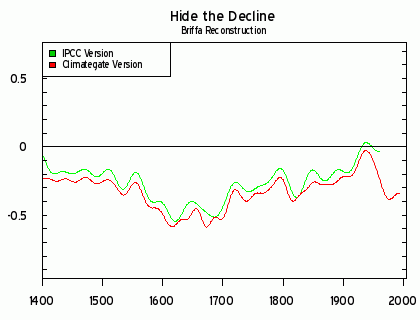
Ok we need to show some warming here, before people believe this is all a SCAM
Mise à jour: RDI m'a répondu en quelque minute avec ceci:
rdimatin@SimonFili Les courriels cités par tous les médias qui parlent "d'astuces" et qui ont donné place à la controverse datent de novembre 1999. rdimatin@SimonFili Est-ce un "mensonge" de votre part de ne parler que des courriels récents dans votre post?
Intéressant de voir ces réponses. Ils affirment en onde que ces courriels datent de 10 ans, ceci donne l'impression que ces informations sont veilles donc sans grande importances.
Il me demande si c'est un mensonge de ne parler que des courriels récents??? La je ne comprends pas. Le point que je fessais était sur le fait que c'est courriels ne dataient pas seulement de 10 ans.
L'information aurait du être comme ceci: Ces courriels couvrent une plage de 10 ans.
Mise à jour #2 Steve McIntyre à fait une analyse approfondie des trucs utilisé par le CRU (ClimateGate). Nous voyons des indices dans des email de 2008. Donc une autre "preuve" que c'est email ne sont pas vieux de 10 ans comme prétendais RDI.
Moyers was speaking at the National Conference for Media Reform, an event that brought together thousands of people dedicated to making America's media system more democratic, diverse and accountable.
Addressing the packed auditorium, Moyers said the work of the media reform movement has "challenged the stranglehold of mega-media corporations over our press" and fostered "alternative and independent sources of news and information that people can trust."
Moyers cited the recent exposés about government propaganda in mainstream media as a symptom of "journalism in profound crisis."
"You couldn't find a more revealing measure of the state of the dominant media today than the continuing ubiquitous presence -- on the air and in print -- of the very pundits and experts, self-selected 'message multipliers' of a disastrous foreign policy, who got it all wrong in the first place," he said.
At the root of this crisis, Moyers said, is media consolidation.
"As conglomerates swallow up newspapers, magazines, publishing houses and broadcast outlets, news organizations are folded into entertainment divisions. The news hole in the print media shrinks to make room for ads, celebrities, nonsense and propaganda, and the news we need to know slips from sight."
Père de deux beaux enfants, en relation avec une jolie femme depuis 30 ans, triathlète, curieux des enjeux humanitaires, architecte sénior en développement technologique chez Bell, humaniste, électronicien. Ma curiosité est sans limites.
IS THIS THE DAWN OF A NEW NUCLEAR AGE?
-
A year ago Donald Trump decided to reignite nuclear power research –– his
goal in June 2025 was to develop three new advanced nuclear reactors and
get th...
Episode 115 - All Subsidies are not Created Equal
-
There's a big difference between "subsidies" the nuclear industry
"receives" and the subsidies granted to the renewable energy industry. Be
sure to sop by ...




 Messages


